2026-06-12 ワシントン大学セントルイス校
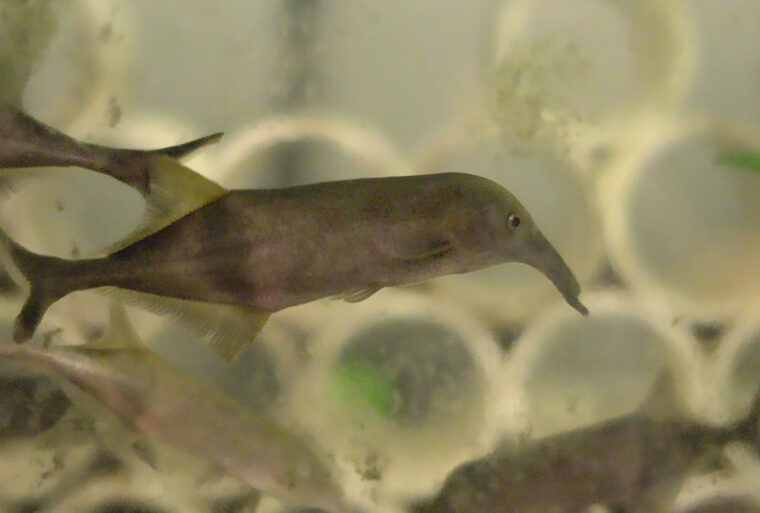
Elephant nose fish from the genus Campylomormyrus are weakly electric in a way that makes them ideal for studying corollary discharge, the way brain systems sort external signals from internal noise. (Photo courtesy of Carlson lab)
<関連情報>
- https://source.washu.edu/2026/06/new-research-reveals-how-brains-update-their-predictions/
- https://www.cell.com/current-biology/fulltext/S0960-9822(26)00572-5
電気魚における相補放電と求心性入力の協調を維持するための感覚運動統合の発達的および進化的変化 Developmental and evolutionary changes in sensorimotor integration to maintain coordination of corollary discharge and afferent input in electric fish
Martin W. Jarzyna ∙ Bruce A. Carlson
Current Biology Published: May 27, 2026
DOI:https://doi.org/10.1016/j.cub.2026.04.068
Highlights
- Electric signals are modified by testosterone, age-related plasticity, and evolution
- Conserved circuits predict sensory responses to self-generated signals as they change
- The same nucleus shifts activity to track changes in individuals and over evolution
- These shifts propagate to sensory neurons, precisely updating sensory predictions
Summary
Nervous systems generate predictions using internal copies of motor commands, termed corollary discharge (CD). CD modulates sensory neurons to distinguish self-generated sensory inputs (reafference) from external inputs (exafference). As behavior changes throughout development and evolution, these predictions must update as reafference changes. However, mechanisms that synchronize CD to reafferent input remain unknown. Mormyrid fish communicate using electric organ discharges (EODs). To distinguish reafferent and exafferent EODs, a CD inhibits sensory neurons whenever a reafferent EOD is produced. EOD duration varies across and within species, and a yet-unknown mechanism precisely time-locks inhibition with reafference. Likewise, seasonal increases in testosterone reversibly elongate male EODs in some species, and testosterone shifts CD timing to match changing reafference. To identify the neural substrates of hormonal CD shifts, we treated Brienomyrus brachyistius with testosterone and recorded field potentials from six nuclei linking electromotor, CD, and electrosensory pathways. Testosterone delayed and elongated field potentials in the mesencephalic command-associated nucleus (MCA) of the CD pathway, which shifted downstream activity. We identified substrates of evolutionary and age-related shifts in two species of Campylomormyrus with dramatically different EODs: one with short-duration EODs and one with long EODs that can elongate as individuals age. Both inter- and intraspecies EOD variation was associated with the onset and duration of MCA field potentials. We find distinct processes—hormonal plasticity over days, age-related changes over years, and evolutionary divergence—converge on a common substrate to synchronize CD with reafference. This suggests that sensorimotor systems can evolve a shared solution for temporal coordination across timescales.