2025-06-15 慶應義塾大学医学部,国立がん研究センター,科学技術振興機構
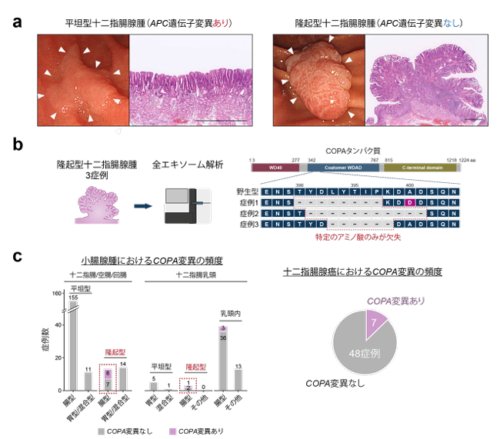
図1:a. 平坦型小腸腺腫と隆起型小腸腺腫の肉眼および病理形態の違い。b. 隆起型小腸腺腫3 例のエキソーム解析によって同定されたCOPA遺伝子のインフレーム欠損。c. 小腸腺腫および十二指腸腺がんにおけるCOPA遺伝子変異の頻度。COPA変異は隆起型腺腫および腺がんでの頻度が高いことがわかる。
<関連情報>
- https://www.keio.ac.jp/ja/press-release/20260615-press-01/
- https://www.keio.ac.jp/fixed-files/20260615-press-01-l8jvds0q.pdf
- https://www.nature.com/articles/s41588-026-02616-9
COPA変異は腸管腫瘍においてR-spondin非依存的なWnt活性化を駆動する Recurrent COPA mutation drives R-spondin-independent Wnt activation in intestinal tumors
Masayuki Fujii,Naoko Abeto,Shotaro Kishimoto,Kouya Shiraishi,Taiki Hashimoto,Nobuyoshi Hiraoka,Satoru Nonaka,Motohiro Kojima,Mami Matano,Sirirat Takahashi,Gabriele Colozza,Bon-Kyoung Koo,Yasushi Yatabe,Motohiko Kato,Toshiro Sato & Shigeki Sekine
Nature Genetics Published:12 June 2026
DOI:https://doi.org/10.1038/s41588-026-02616-9
Abstract
The majority of intestinal tumors harbor mutations in canonical Wnt pathway genes such as APC, whereas the lack of such alterations in a subset of tumors implies alternative tumorigenic routes. Here we identify recurrent in-frame deletion in COPA, frequently co-occurring with USP9X-truncating mutation, in small intestinal adenoma and adenocarcinoma. Patient-derived and CRISPR-engineered small intestinal organoids carrying COPA in-frame deletions exhibit R-spondin-independent yet Wnt ligand-dependent growth, maintaining LGR5 expression without canonical Wnt drivers. Mechanistically, COPA mutation stabilizes the Frizzled coreceptor LRP6 irrespective of R-spondin, sustaining Wnt pathway activation under growth factor-restricted conditions. USP9X loss further potentiates this phenotype. Unlike canonical Wnt pathway members, COPA encodes the α-subunit of coatomer complex I, which engages in vesicle trafficking with little prior linkage to intestinal tumorigenesis. Our findings establish COPA mutation as a unique and atypical intestinal tumor driver and implicate USP9X loss as a cooperating lesion.