2026-06-17 ノースウェスタン大学
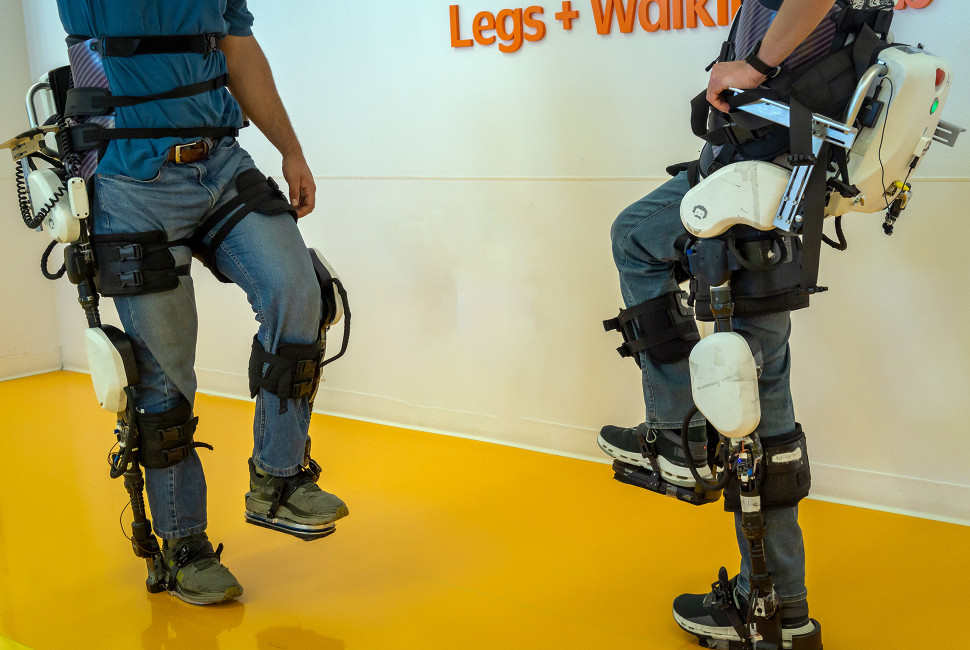
The Northwestern and Shirley Ryan AbilityLab team developed a novel intervention wherein a therapist and stroke survivor each wear a lower-limb exoskeleton virtually connected at the hips and knees. The connection behaves like a combination of springs and shock absorbers, allowing therapists and patients to influence each other’s movements in real time. Photo courtesy of the Shirley Ryan AbilityLab
<関連情報>
- https://news.northwestern.edu/stories/2026/06/new-exoskeleton-therapy-could-redefine-how-stroke-survivors-relearn-to-walk
- https://www.science.org/doi/10.1126/scirobotics.adz9628
歩行療法におけるセラピスト・外骨格・患者の相互作用 Therapist-exoskeleton-patient interaction for gait therapy
Emek Barış Küçüktabak, Matthew R. Short, Lorenzo Vianello, Daniel Ludvig, […] , and Jose Pons
Science Robotics Published:17 Jun 2026
DOI:https://doi.org/10.1126/scirobotics.adz9628
Abstract
After a stroke, individuals often experience mobility impairments because of weakness and loss of independent joint control in the lower limbs. As a result, gait recovery becomes a primary goal of physical rehabilitation, traditionally achieved through high-intensity therapist-led training. However, conventional therapist-led approaches involving manual assistance or resistance can be physically demanding and limit interaction at multiple joints simultaneously. Robotic exoskeletons have emerged as a promising solution, enabling multijoint support, reducing therapist strain, and offering objective performance feedback. However, typical exoskeleton control strategies limit the physical therapist’s involvement and adaptability to the patient’s needs, which may hinder clinical adoption and outcomes. In this study, we introduce a gait rehabilitation paradigm based on physical human-robot-human interaction that we call therapist-exoskeleton-patient interaction (TEPI), in which a therapist and a patient with stroke are each equipped with a lower-limb exoskeleton virtually connected at the hips and knees via spring-damper elements. This connection enables bidirectional physical interaction, allowing the therapist to guide the patient’s movement while receiving real-time haptic feedback. We evaluated this approach with eight patients with chronic stroke using a within-subject design, comparing TEPI training with conventional therapist-guided mobilization during treadmill walking. Results showed that, compared with conventional therapy, TEPI led to greater joint range of motion, increased step length and height, similar muscle activation, and high self-reported motivation and enjoyment. These findings suggest that TEPI can integrate robotic precision with therapist intuition, offering a framework for enhancing gait rehabilitation outcomes in populations recovering from stroke.