026-06-17 ハーバード大学
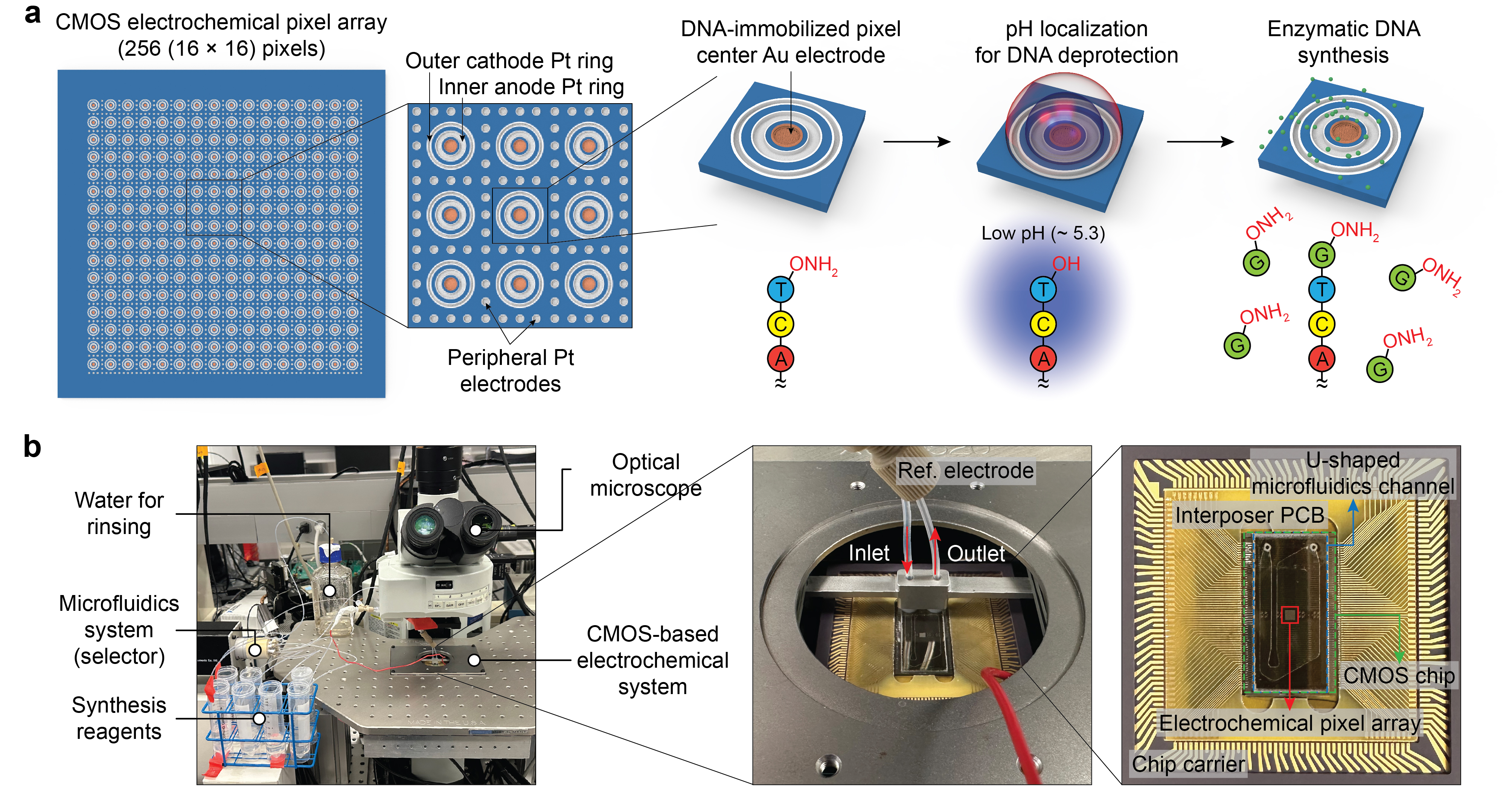
A schematic of core steps in the enzymatic synthesis platform.
<関連情報>
- https://seas.harvard.edu/news/making-dna-semiconductor-chip
- https://www.nature.com/articles/s41928-026-01662-9
半導体チップを用いた並列酵素DNA合成 Parallel enzymatic DNA synthesis using a semiconductor chip
Woo-Bin Jung,Han Sae Jung,Jun Wang,Henry Hinton,Seok Joo Kim,Yuchang Zhang,Suyue Chen,Young-Ha Hwang,Maxime Fournier,Manon Boul,Kevin Grosselin,Adrian Horgan,Xavier Godron,Robert Nicol & Donhee Ham
Nature Electronics Published:17 June 2026
DOI:https://doi.org/10.1038/s41928-026-01662-9
Abstract
Parallelized DNA synthesis across a dense array of sites is crucial to high-throughput synthetic biology and diagnostics and could potentially be used for DNA-based data storage. Phosphoramidite synthesis can achieve substantial parallelism but relies on harmful solvents and centralized facilities. Enzymatic DNA synthesis in mild aqueous solution is safer and could be more accessible, but parallel demonstrations remain modest at an early stage. Here we show that a complementary metal–oxide–semiconductor chip can be used to perform parallel enzymatic DNA synthesis of up to 64 distinct 38–39-nucleotide sequences (10–11-nucleotide feature sequences). The chip controls an array of 256 ring-electrode pairs (each one a programmable synthesis site) that can create an arbitrary pattern of localized acidity to enable DNA deprotection and subsequent enzymatic nucleotide incorporation. We also illustrate the potential of this parallel synthesis for data storage by encoding a 169-byte text. Our mechanistic analysis shows that shifting from an indirect to a direct local-acid chemistry route could lead to higher-throughput enzymatic synthesis that can scale with the complementary metal–oxide–semiconductor chip.