2026-06-15 マサチューセッツ工科大学(MIT)
<関連情報>
- https://news.mit.edu/2026/tiny-ingestible-sensor-can-measure-temperature-inside-body-0615
- https://www.nature.com/articles/s41928-026-01643-y
体内温度を継続的にモニタリングするための小型経口摂取型温度センサー A miniaturized ingestible temperature sensor for continuous internal monitoring
Saransh Sharma,Yubin Cai,Injoo Moon,Zhenming Yang,Peter Chai,Niora Fabian,Kailyn Schmidt,Alison M. Hayward,Andrew Pettinari,Maria Platero,Benedict Laidlaw,Ashley Guevara,Anantha P. Chandrakasan & Giovanni Traverso
Nature Electronics Published:15 June 2026
DOI:https://doi.org/10.1038/s41928-026-01643-y
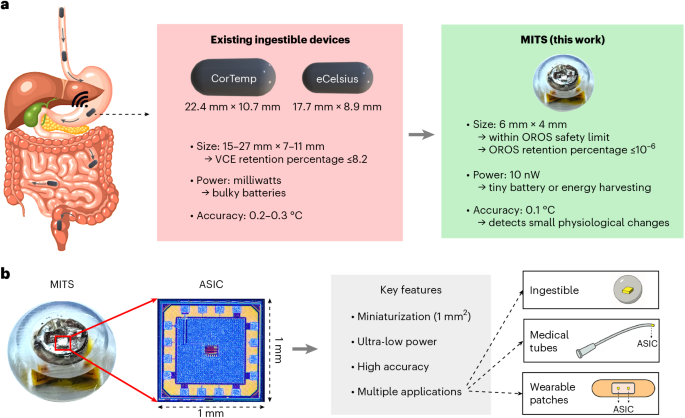
Fig. 1: MITS overview.
Abstract
Ingestible electronic systems offer a minimally invasive means to continuously monitor core body temperature, providing critical insights into a range of health conditions. However, the size of ingestible sensors often limits their use, particularly in paediatric populations. Here we report a miniaturized ingestible temperature sensor for continuous internal monitoring. The device integrates a 1 mm × 1 mm low-power (10 nW) integrated circuit, a 5 mm × 5 mm antenna for wireless backscatter communication and a coin-cell battery. The fully encapsulated system measures just 6 mm in diameter and 4 mm in height, dimensions aligned with those of US Food and Drug Administration-approved osmotic controlled-release oral delivery system and smaller than video capsule endoscopy devices, thus minimizing the risk of gastrointestinal retention. We evaluate the sensor in swine models under diverse physiological and pathophysiological conditions. This includes use in ambulatory multi-day monitoring, scenarios with inflammation-induced altered gastrointestinal transit and deployment alongside intravascular devices for vascular navigation and guidance.