2026-06-22 マウントサイナイ医療システム(MSHS)
<関連情報>
- https://www.mountsinai.org/about/newsroom/2026/wearable-devices-may-help-detect-cytokine-release-syndrome-earlier-in-patients-receiving-car-t-therapy
- https://insight.jci.org/articles/view/203988
骨髄腫に対するCAR-T療法後のウェアラブルデバイスとサイトカインプロファイリングを用いたサイトカイン放出症候群の検出 Detection of cytokine release syndrome using wearables and cytokine profiling following CAR-T therapy for myeloma
Sridevi Rajeeve, Matt Wilkes, Nicole Zahradka, Lewis Tomalin, Mujahid Quidwai, Darren Pan, Nicholas J. Calafat, Martin Cusack, Adolfo Aleman, Kseniya Serebryakova,, Katerina Kappes, Hayley Jackson, Sarita Agte, Santiago Thibaud, Larysa Sanchez, Shambavi Richard, Joshua Richter, Cesar Rodriguez, Hearn Jay Cho,Ajai Chari, Sundar Jagannath, Alessandro Laganà, Adriana C. Rossi, and Samir Parekh
JCI Insight Published: May 5, 2026
DOI:https://doi.org/10.1172/jci.insight.203988
Graphical Abstract
Abstract
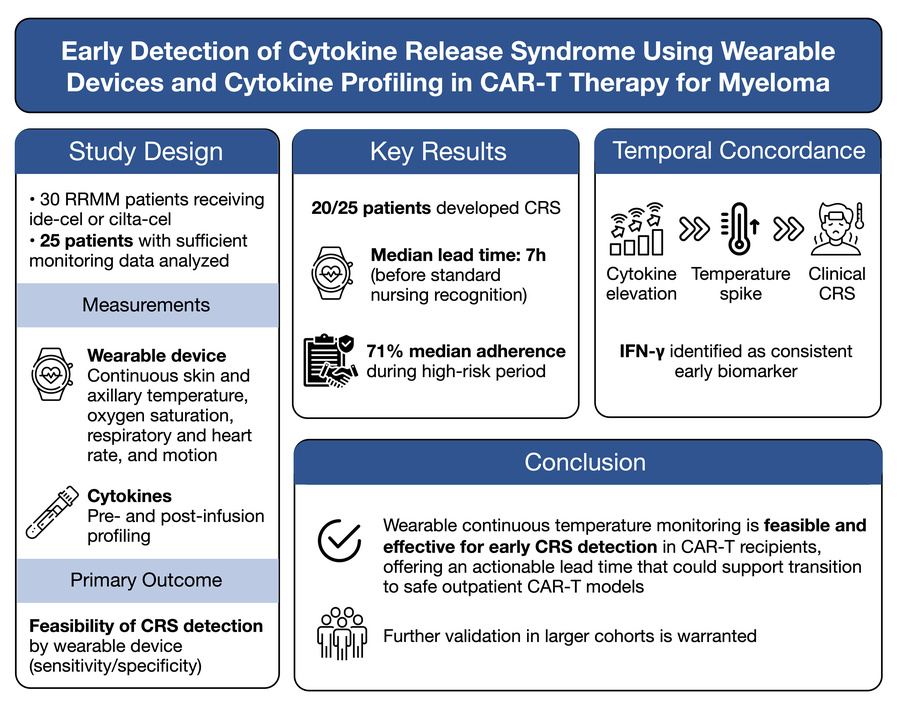
BACKGROUND. Chimeric antigen receptor T-cell (CAR-T) therapies have revolutionized treatment for relapsed/refractory multiple myeloma (RRMM). However, cytokine release syndrome (CRS), a common and potentially severe complication, requires inpatient monitoring, limiting access and increasing costs. Wearable devices could support outpatient CAR-T delivery, but feasibility for CRS detection versus standard care remains unproven.
METHODS. We conducted a prospective, single-center observational pilot study to assess the feasibility of using wearable devices for monitoring vital signs and detecting CRS. Thirty patients receiving idecabtagene vicleucel (ide-cel) or ciltacabtagene autoleucel (cilta-cel) were enrolled; 25 with sufficient monitoring data were evaluable. Sensors collected skin and axillary temperature, oxygen saturation, respiratory and heart rate, and motion. Peripheral blood cytokines were analyzed pre- and postinfusion using a multiplex proteomic platform. The primary outcome was feasibility, assessed by CRS detection sensitivity and specificity; secondary outcomes included adherence, lead time, and performance of models integrating wearable and cytokine data.
RESULTS. CRS occurred in 20 of 25 patients. The best-performing wearable model detected 18 or 20 CRS episodes with a sensitivity of 0.72 (mean 0.75; 95% CI 0.60–0.91) and a specificity of 0.80 (mean 0.76; 95% CI 0.68–0.84), and a median lead time of 7:00 hours before nursing recognition. Median adherence during high-risk periods was 71%. Cytokine changes paralleled temperature elevations, and IFN-γ emerged as a consistent biomarker.
CONCLUSION. Wearable devices are feasible for early CRS detection and may support outpatient CAR-T care. Larger outpatient studies are warranted.
TRIAL REGISTRATION. This study did not meet the criteria for ClinicalTrials.gov registration.