20206-06-23 徳島大学
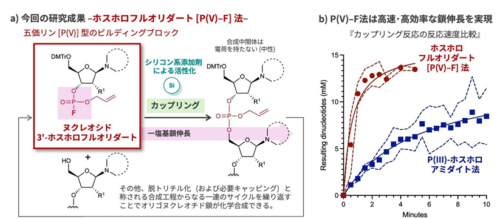
図 2 今回の研究成果『ホスホロフルオリダート [P(V)–F法]』
<関連情報>
- https://www.tokushima-u.ac.jp/docs/72323.html
- https://www.tokushima-u.ac.jp/fs/5/0/5/6/3/3/_/20260622pressrelease.pdf
- https://pubs.acs.org/doi/10.1021/jacs.6c04623
P(V)ベースのオリゴヌクレオチド合成のためのヌクレオシド3′-ホスホロフルオロデート Nucleoside 3′-Phosphorofluoridates for P(V)-Based Oligonucleotide Synthesis
Nana Mihara,Syuya Inoue,Kazuho Okunishi,Yasufumi Fuchi,Yuta Ito,Yoshiyuki Hari,Tsubasa Inokuma,Noriaki Minakawa,and Noriko Saito-Tarashima
Journal of the American Chemical Society Published: June 19, 2026
DOI:https://doi.org/10.1021/jacs.6c04623
Abstract
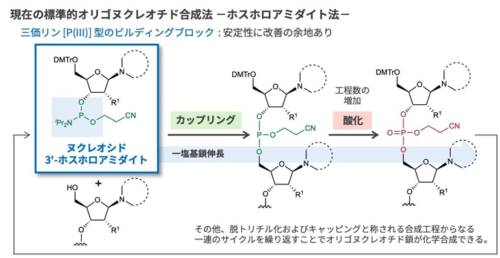
Oligonucleotides (ONs) are fundamental to modern life sciences and nucleic acid-based therapeutics. Although P(III)-based phosphoramidite chemistry remains industry standard for ON synthesis, its requirement for phosphorus oxidation every coupling cycle is operationally complex. Inspired by Michelson and Todd, who synthesized the first dinucleotide via a 3′-phosphorochloridate [P(V)–Cl] intermediate, we have developed a strategy for ON synthesis using nucleoside 3′-phosphorofluoridates [P(V)–F] as bench-stable building blocks. In the presence of silicon-based activators, the enhanced reactivity of the P(V)–F bond resulted in more efficient nucleotide coupling than conventional P(III)-based phosphoramidite chemistry. Furthermore, automated solid-phase synthesis of a 20-mer ON can be achieved on a standard DNA/RNA synthesizer. Our study demonstrates that P(V)-based phosphorofluoridate chemistry facilitates oxidation-free ON synthesis, providing a complementary approach to conventional P(III)-based phosphoramidite chemistry.