2026-06-24 北海道大学,生命創成探究センター
酵素の機能変化に基づくブロック共重合体の合成
<関連情報>
重合反応によるPHA合成酵素の機能変化がブロック共重合を引き起こす Polymerization-Induced Functional Switching of Engineered Polyhydroxyalkanoate Synthase Directs Block Copolymerization
Kengo Yanagawa,Atsuji Kodama,Hiroya Tomita,Shunsuke Kita,Shin-ichi Hachisuka,Hiroshi Kikukawa,Susumu Uchiyama,Katsumi Maenaka,Ken’ichiro Matsumoto
Journal of the National Academy of Sciences Published: June 14, 2026
DOI:https://doi.org/10.1021/jacs.6c04919
Abstract
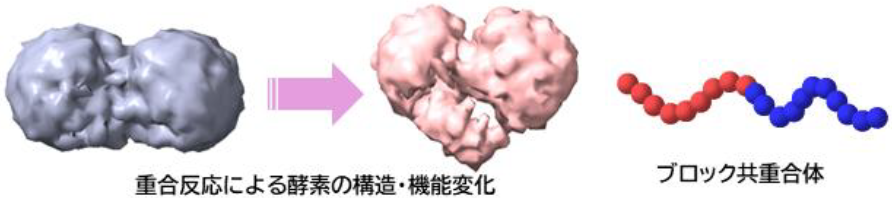
Enhancing the physical properties and functionality of polyhydroxyalkanoates (PHA) is essential for expanding their applications, and controlling monomer sequence is central to this goal. Finding the first sequence-regulating PHA synthase, PhaCAR, previously enabled to biosynthesize PHA block copolymers, whereas the molecular mechanism underlying the spontaneous block copolymerization has remained unclear. In this study, we elucidated the mechanism using an in vitro assay system developed to monitor multisubstrate reactions. Poly(3-hydroxybutyrate)-block-poly(2-hydroxybutyrate) [P(3HB)-b-P(2HB)] was selected as a model block copolymer. Purified PhaCAR synthesized P(3HB)-b-P(2HB) from a mixture of substrates, 3HB-coenzyme A (CoA) and 2HB-CoA, indicating that the in vitro system closely reproduced in vivo polymer production. During the reaction, PhaCAR initially can polymerize only 3HB-CoA, forming the first P(3HB) segment. After this, P(3HB)-bound PhaCAR exhibited activity toward 2HB-CoA, indicating that the first-step reaction changed the function of PhaCAR. To create a state where polymerization proceeds uniformly, substrate analogs of oligomeric 3HB were prepared that can mimic the enzyme in the middle of the reaction. The oligomer-bound PhaCAR also exhibited activity toward 2HB-CoA, depending on oligomer length. The functional enhancement was associated with the PhaCAR’s conformational change, as revealed by cryo-electron microscopy. During the synthesis of the second segment, 2HB-CoA was found to inhibit 3HB-CoA polymerization, enabling the synthesis of the P(2HB) homopolymer segment in the presence of 3HB-CoA. Overall, the results demonstrated the novel sequence-regulating mechanism based on the polymerization-induced functional enhancement. The findings would be useful to further expand the structural variety of PHA for a wider range of applications.