2026-07-01 東京科学大学
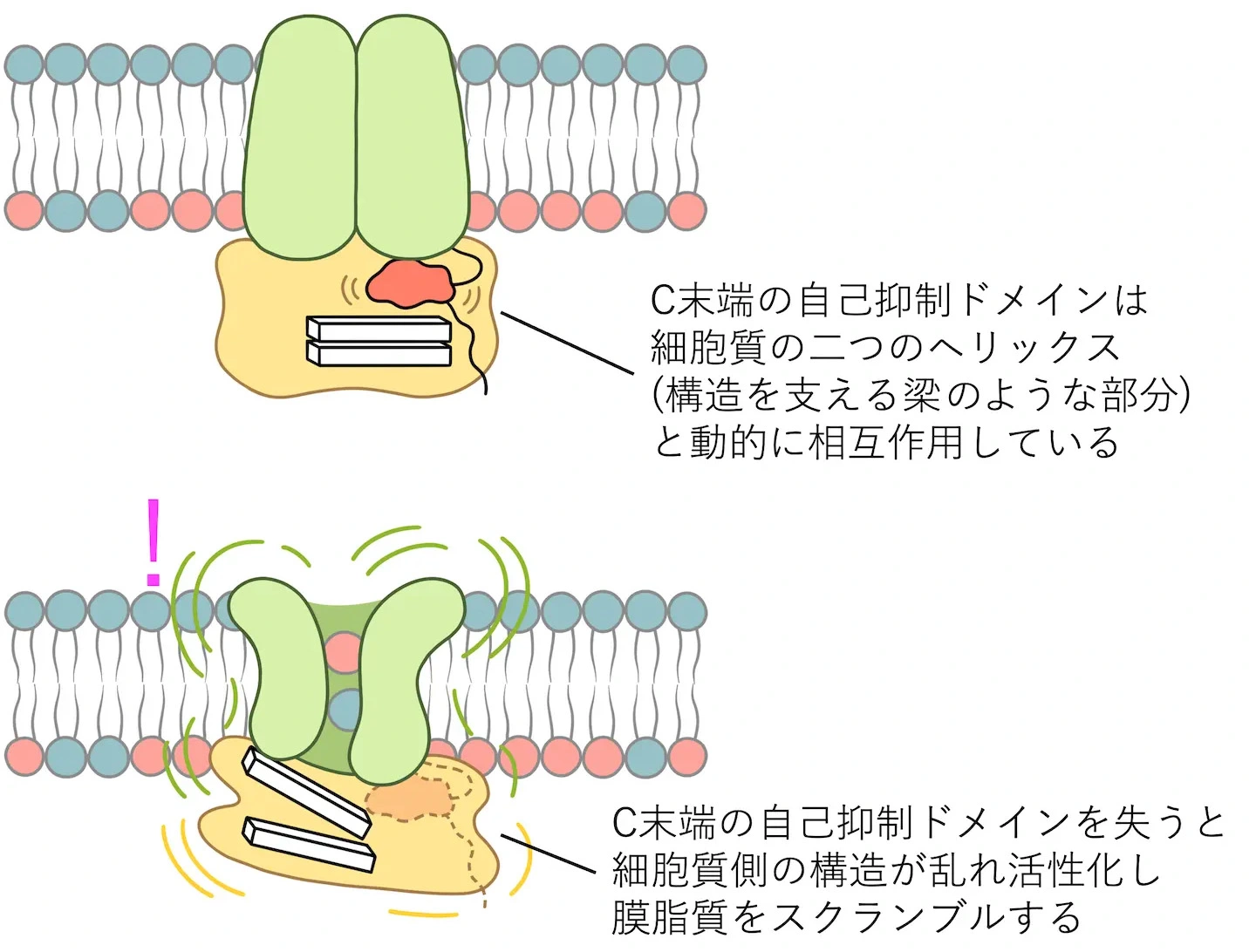
図1. 膜変形応答性スクランブラーゼTMEM63BのC末端領域による自己抑制
<関連情報>
- https://www.isct.ac.jp/ja/news/q6aryjog1wp1#top
- https://www.jbc.org/article/S0021-9258(26)02095-8/fulltext
機械感受性脂質スクランブラーゼTMEM63BのC末端テールによる自己阻害 Autoinhibition of the mechanosensitive lipid scramblase TMEM63B by its C-terminal tail
Megumi Nishimura ∙ Yugo Miyata ∙ Yu Shiraki ∙ … ∙ Norimichi Nomura ∙ Tomohiro Nishizawa ∙ Katsumori Segawa
Journal of Biological Chemistry Published:June 4, 2026
DOI:https://doi.org/10.1016/j.jbc.2026.113223
Abstract
TMEM63B belongs to the OSCA/TMEM63 family of mechanosensitive ion channels. We recently identified it as a mechanosensitive lipid scramblase activated by changes in membrane physical properties. Cryo-EM analysis revealed that recombinant mouse TMEM63B (mTMEM63B) protein adopts either closed or open conformations depending on the detergent environment, and that the monoclonal antibody YN9303-24 stabilizes the open state; however, the antibody epitope and the mechanism of antibody-dependent conformational regulation remained unclear. Here, using chimeric constructs, C-terminal truncations, and internal deletions, we mapped the YN9303-24 epitope to the intracellular C-terminal tail and identified the AQV motif (residues 773–775) as the core binding determinant. Functional analyses revealed that this C-terminal region is essential for maintaining TMEM63B in an inactive state under resting conditions. Deletion of the adjacent LQD motif (Δ776–778) or substitution of Leu776 with alanine induced strong constitutive lipid scrambling, evidenced by phosphatidylserine externalization and enhanced incorporation of fluorescently labeled phosphatidylcholine, whereas substitutions at Gln777 or Asp778 had minimal effects. Structural analysis positioned the AQVLQD motif adjacent to conserved intracellular helices in the open conformation, with Leu776 located near several hydrophobic residues. Together, these findings identify an autoinhibitory role for the C-terminal tail region in maintaining TMEM63B in an inactive state, suggesting that interactions between this tail and intracellular helices regulate the activity of this mechanosensitive lipid scramblase.