2026-07-19 東京大学
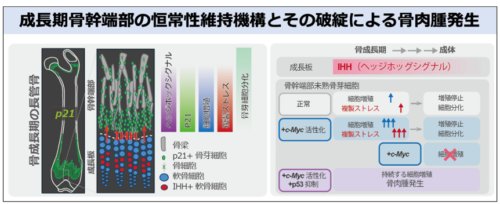
図1:本研究の概要
<関連情報>
若年者の骨幹端における固有の組織恒常性は、骨肉腫発生の基盤となる Inherent tissue homeostasis of the juvenile metaphysis provides a foundation for osteosarcoma development
Masato Saito,Fumie Nakasuka,Nao Sankoda,Yihan Wang,Jumpei Taguchi,Sho Ohta,Yosuke Yamada,Manabu Ozawa,Satoko Sakurai,Atsushi Kondo,Tetsuo Ushiku,Robert Nakayama,Masaya Nakamura,Hiroshi Takayanagi,Atsushi Shibata,Takuya Yamamoto & Yasuhiro Yamada
Nature Communications Published:26 June 2026
DOI:https://doi.org/10.1038/s41467-026-74929-6
Abstract
Osteosarcomas preferentially arise in the metaphysis of juvenile long bones, near the growth plate, unlike most cancers, whose incidence increases with age. Here, we show that p21, a negative regulator of the cell cycle, is induced in proliferating juvenile metaphyseal osteoblasts in response to DNA replication-associated damage. Single-cell RNA sequencing defines a differentiation hierarchy from multipotent progenitors to mature osteoblasts and identifies immature osteoblasts enriched for proliferation and replication stress responses. p21-positive metaphyseal osteoblasts associate with growth plate Indian hedgehog expression and decline after growth plate maturation or Hedgehog inhibition. c-Myc induction selectively promotes juvenile osteoblast proliferation despite p53 activation, but this proliferative response remains Hedgehog-dependent and ceases after growth plate maturation. By contrast, p53 inactivation enables sustained Hedgehog-independent proliferation of c-Myc-induced osteoblasts and lung metastasis. These findings reveal juvenile metaphyseal tissue homeostasis as a potential basis for the age of onset, anatomical specificity, and mutational profile of human osteosarcomas.