2026-07-08 電気通信大学
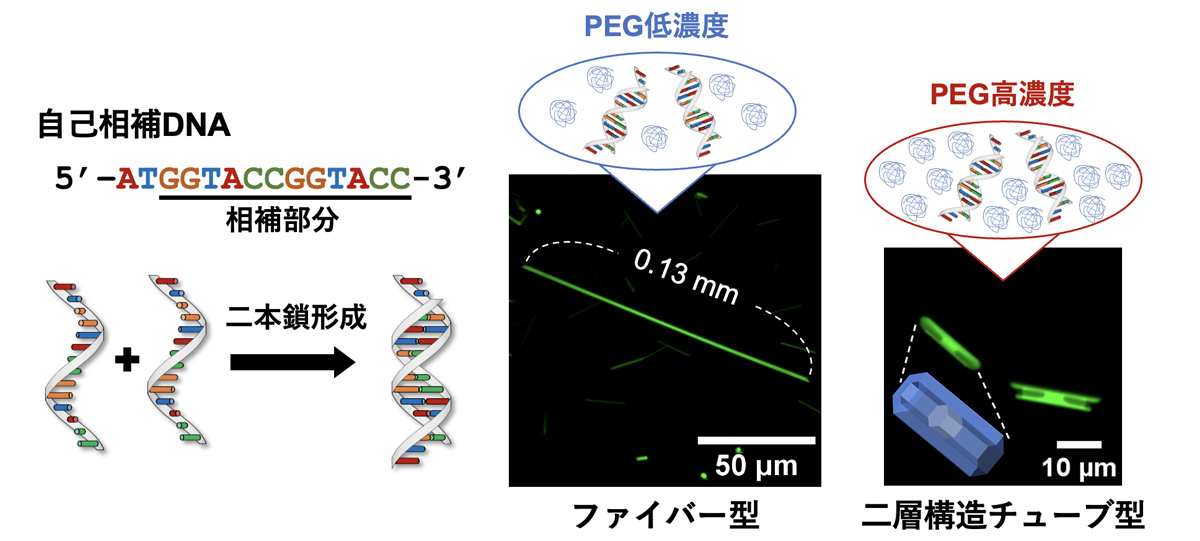
概要図:自己相補DNAの配列および、PEGの濃度に応じて形成されたDNAのファイバー型・二層構造チューブ型の液晶集合体の蛍光顕微鏡画像。
<関連情報>
- https://www.uec.ac.jp/news/newsrelease/2026/20260708_7814.html
- https://onlinelibrary.wiley.com/doi/10.1002/anie.6741643
単一の自己相補的DNAオリゴヌクレオチドから形成される繊維および二重層チューブ Fibers and Double-Layered Tubes Formed From a Single Self-Complementary DNA Oligonucleotide
So Shirai, Tetsunao Makino, Takashi Kajitani, Makiko Tanaka
Angewandte Chemie International Edition Published: 23 June 2026
DOI:https://doi.org/10.1002/anie.6741643
ABSTRACT
This study reports the first observation that a short self-complementary DNA oligonucleotide can self-assemble into two distinct liquid-crystalline architectures—long fibers and double-layered molecular tubes—upon thermal annealing. These two morphologies are determined by depletion forces tuned by the concentration of poly(ethylene glycol) (PEG) in solution. At lower PEG concentrations (25–30w/v%), the depletion forces between duplexes are relatively weak. Under these conditions, nucleation occurs only at lower temperatures after sufficient duplex DNA has formed, leading to predominantly longitudinal growth and the formation of elongated DNA fibers. Small-angle X-ray scattering (SAXS) revealed a single columnar hexagonal packing structure within these fibers. At higher PEG concentrations (35–40w/v%), the depletion forces become stronger. Under these conditions, nucleation occurs even at elevated temperatures, where the amount of duplex is still limited, leading to the formation of tubular assemblies. SAXS measurements conducted on the tubular DNA assemblies revealed two separate hexagonal lattice constants, suggesting differences in packing density between the inner core and the outer framework. This work establishes a new direction in DNA-based materials design, demonstrating that hierarchical liquid-crystalline architectures can emerge from a single short DNA oligonucleotide simply by tuning molecular crowding conditions.