2026-07-15 国立がん研究センター,理化学研究所,東海大学,旭川医科大学,株式会社ヒューマノーム研究
<関連情報>
- https://www.ncc.go.jp/jp/information/pr_release/2026/0715/index.html
- https://www.nature.com/articles/s41746-026-02695-2
神経膠腫におけるIDH変異状態の予測における人工知能と医師のパフォーマンスの比較 Comparing artificial intelligence and physician performance in predicting IDH mutation status in glioma
Satoshi Takahashi,Masamichi Takahashi,Manabu Kinoshita,Mototaka Miyake,Risa Kawaguchi,Naoki Shinojima,Akitake Mukasa,Kuniaki Saito,Motoo Nagane,Ryohei Otani,Fumi Higuchi,Shota Tanaka,Nobuhiro Hata,Kaoru Tamura,Kensuke Tateishi,Ryo Nishikawa,Hideyuki Arita,Masahiro Nonaka,Takehiro Uda,Junya Fukai,Yoshiko Okita,Naohiro Tsuyuguchi,Yonehiro Kanemura,Fumiyasu Tsushima,… Ryuji Hamamoto
npj Digital Medicine Published:05 May 2026
DOI:https://doi.org/10.1038/s41746-026-02695-2
Abstract
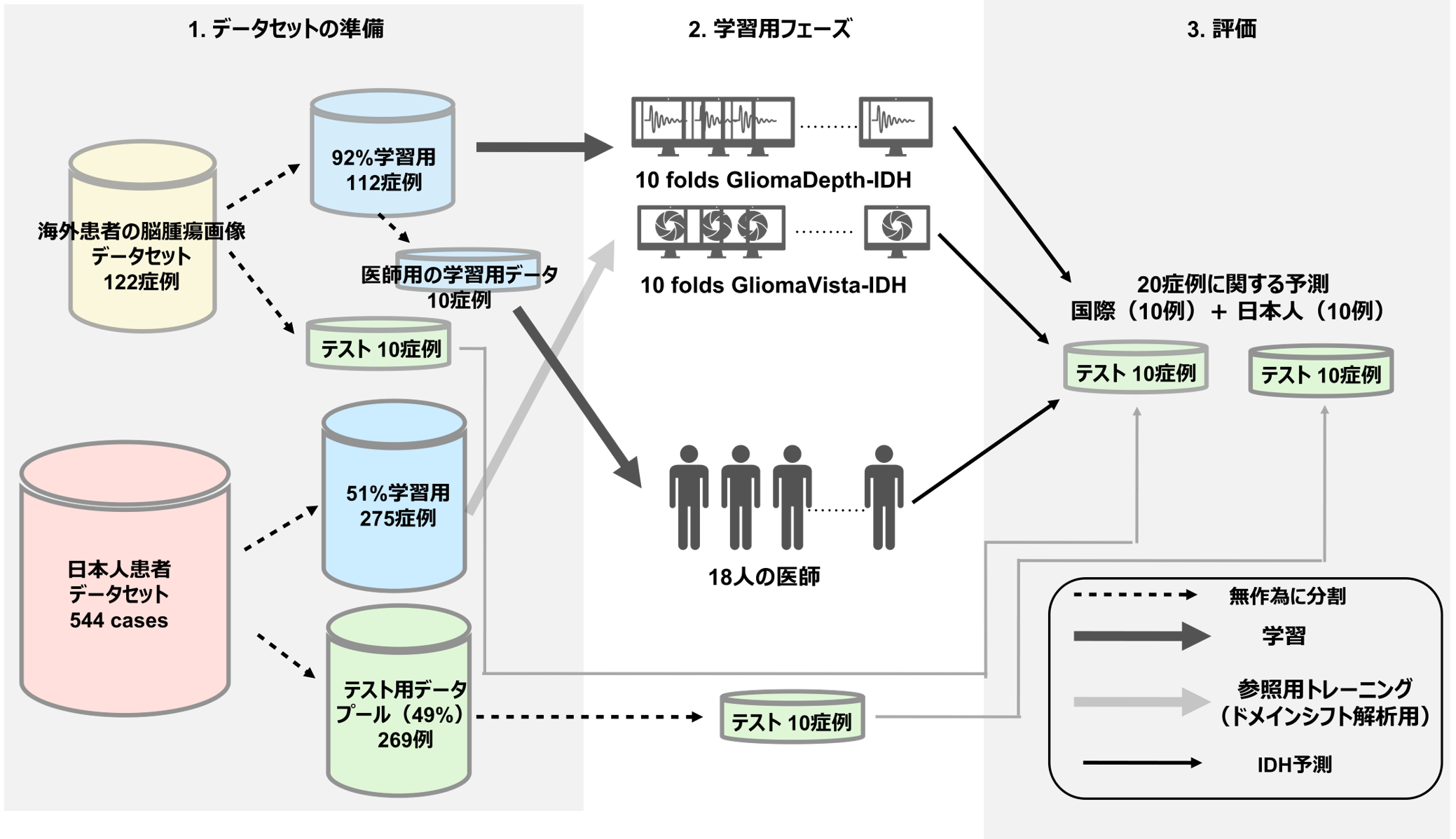
Predicting isocitrate dehydrogenase (IDH) mutations in gliomas using magnetic resonance imaging (MRI) is clinically important for treatment planning. This study compared two artificial intelligence (AI) models, GliomaDepth-IDH (ResNet34-based) and GliomaVista-IDH (Vision Transformer-based), with 18 physicians (eight neuroradiologists, five neurosurgeons, and five neurosurgery residents) in predicting IDH mutation status. On the Brain Tumor Segmentation Challenge dataset, the GliomaVista-IDH AI model achieved an area under the curve (AUC) value of 0.97, significantly outperforming all physician groups. However, external validation on a Japanese cohort revealed performance degradation: GliomaDepth-IDH declined to an AUC of 0.75 and GliomaVista-IDH to 0.82, with GliomaVista-IDH showing significant calibration issues (Brier score = 0.32). High-performing physicians achieved comparable results (AUC = 0.88) with superior calibration (Brier score = 0.19). Inter-rater reliability analysis revealed substantial variability across physician groups. These findings suggest that AI models can assist many physicians, while experienced practitioners remain competitive with better-calibrated predictions in challenging domains.