2026-07-21 バーミンガム大学
<関連情報>
- https://www.birmingham.ac.uk/news/2026/sudden-cardiac-death-condition-shown-to-have-linked-genetic-variations
- https://www.nature.com/articles/s41467-026-75392-z
α-アクチニン-2変異体の包括的な生物物理学的および構造的プロファイリングにより、肥大型心筋症におけるメカニズムの多様性が明らかになった Comprehensive biophysical and structural profiling of alpha-actinin-2 variants reveals mechanistic diversity in hypertrophic cardiomyopathy
Maya Noureddine,Halina Mikolajek,Nathan Cowieson,Nikos Pinotsis,Paul Robinson,Alexandre Slater,Charles Redwood,Siobhan Loughna,Chris Denning,Fiyaz Mohammed & Katja Gehmlich
Nature Communications Published:21 July 2026
DOI:https://doi.org/10.1038/s41467-026-75392-z
Abstract
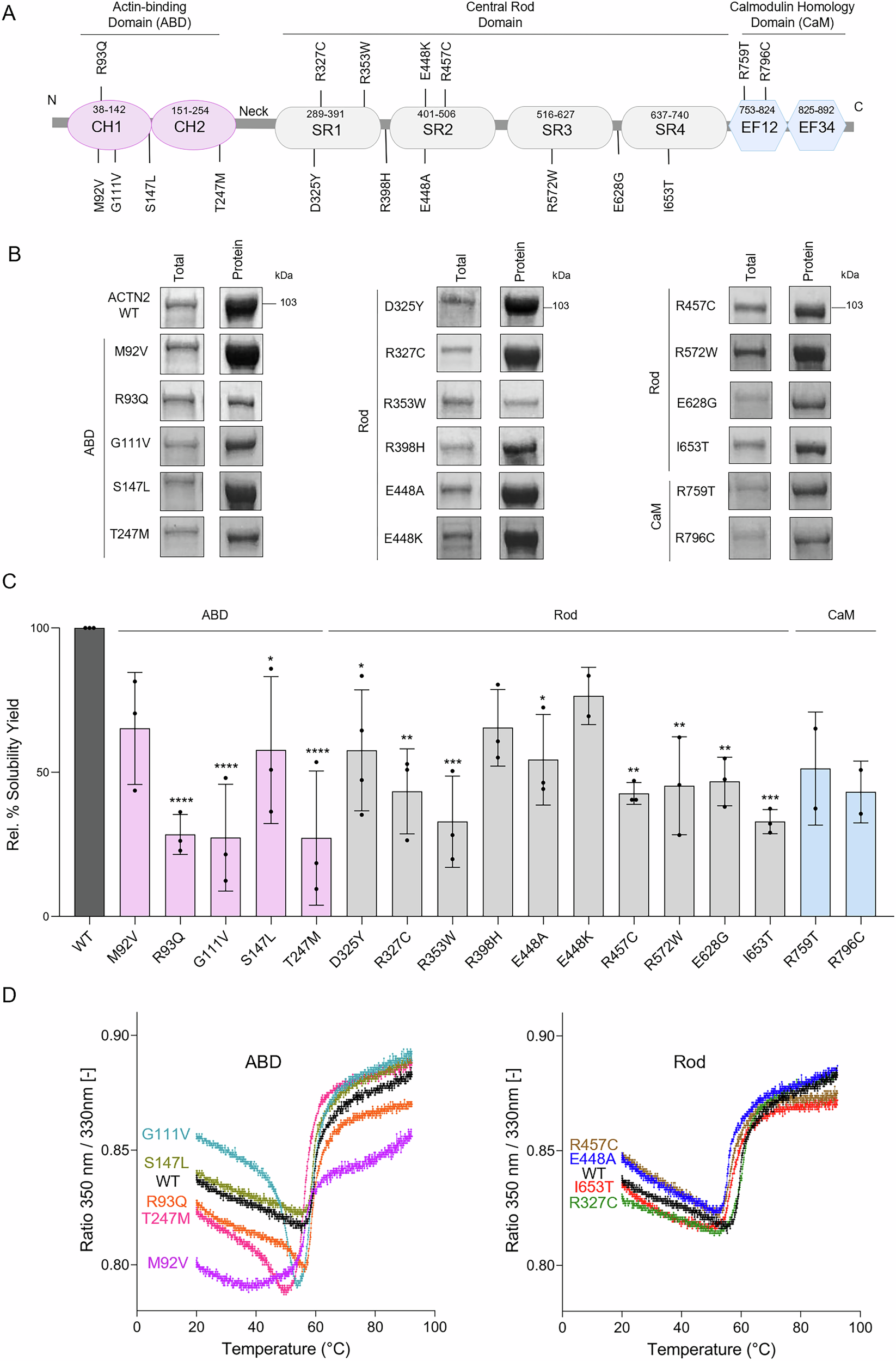
Hypertrophic cardiomyopathy (HCM) is a genetic disease associated with sudden cardiac death. Variants in alpha-actinin-2 (ACTN2), a Z-disc protein that anchors actin thin filaments have been implicated in HCM, yet their structural consequences remain poorly defined. Here, we characterise seventeen HCM-associated ACTN2 variants spanning multiple domains using an integrated and tiered workflow combining high-throughput assays, structural modelling and biophysical approaches. All variants display reduced solubility, with actin-binding domain (ABD) substitutions showing pronounced thermal instability by differential scanning fluorimetry. Modelling of nine variants predicts diverse pathogenic mechanisms including compromised actin-binding, impaired ABD regulatory conformations, disrupted dimerisation interfaces, and perturbed domain architecture. Crystal structures of two rod-domain variants reveal intact dimerisation despite modelling predictions. Actin-binding assays for ABD variants confirm altered actin engagement suggesting that binding dynamics may drive pathogenicity. Limited proteolysis indicates reduced structural stability across variants, while size-exclusion chromatography coupled with multi-angle light scattering or small-angle X-ray scattering (SEC-MALS/SAXS) shows a strong propensity for aggregation. Batch-mode SAXS further demonstrates early aggregation onset in selected ABD variants at elevated temperatures. Collectively, these findings establish that HCM-linked ACTN2 variants compromise protein integrity through multiple mechanisms, highlight the ABD as a hotspot of vulnerability and provide a potential framework for interpreting cardiomyopathy-associated variants.