2026-07-21 ミュンヘン大学(LMU)
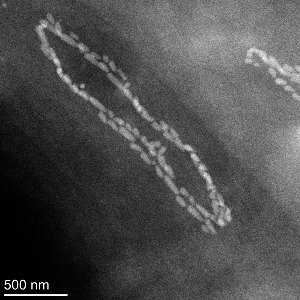
Pearl necklace-shaped magnetosome chains of the endosymbiotic bacterium. © Elena Sturm / PNAS
<関連情報>
- https://www.lmu.de/en/newsroom/news-overview/news/unique-symbiosis-bestows-magnetic-sense-to-single-celled-organism-02593e69.html
- https://www.pnas.org/doi/10.1073/pnas.2609513123
嫌気性繊毛虫における三者共生による磁気走性 Magnetotaxis in an anaerobic ciliate via tripartite syntrophy
Mitali Chitnis, Leon Kaub, Peter Vďačný, +11 , and William D. Orsi
Proceedings of the National Academy of Sciences Published:July 20, 2026
DOI:https://doi.org/10.1073/pnas.2609513123
Abstract
Magnetotaxis has evolved independently numerous times in bacteria, whereby genetically controlled biomineralization of nano-crystalline magnets results in swimming along Earth’s magnetic field lines. Compared to magnetotactic bacteria (MTB), evolutionary mechanisms of magnetotaxis as a trait in eukaryotes remain poorly understood. Here, we report a magnetotactic ciliate, Tropidoatractus magnetotacticus sp. nov., that acquires magnetotaxis via syntrophy. T. magnetotacticus exhibits magnetotaxis due to the magnetic moment of internal ferrimagnetic magnetite (Fe3O4) nanoparticles forming ellipsoidal “necklace-shaped” parallel chains. Electron microscopy revealed T. magnetotacticus hosts numerous internal rod-shaped bacteria containing these magnetosome chains. Consistent with this, a genomic population of MTB (Thermodesulfobacteriota) in magnetically sorted T. magnetotacticus cells was found that encoded and expressed a magnetosome gene cluster responsible for magnetosome Fe3O4 biomineralization closely related to that of the ectosymbiont “Candidatus Desulfarcum epimagneticum.” T. magnetotacticus also housed a second genomic population affiliated with the endosymbiotic methanogen Methanoregula. Metatranscriptomes of sorted T. magnetotacticus cells show eukaryotic hydrogenosomal Fe-hydrogenase gene expression, and expression of genes encoding proteins in an electron transport chain indicative of H2-producing mitochondria-related organelles. Active gene expression of energy metabolism pathways indicates a tripartite syntrophic network whereby anaerobic fermentation products from T. magnetotacticus are consumed by two syntrophic partners: MTB producing the magnetosome chains and hydrogenotrophic methanogens. Our findings show how magnetotaxis can emerge as a trait in eukaryotes via syntrophic cooperation.