2026-09-03 パシフィック・ノースウェスト国立研究所(PNNL)
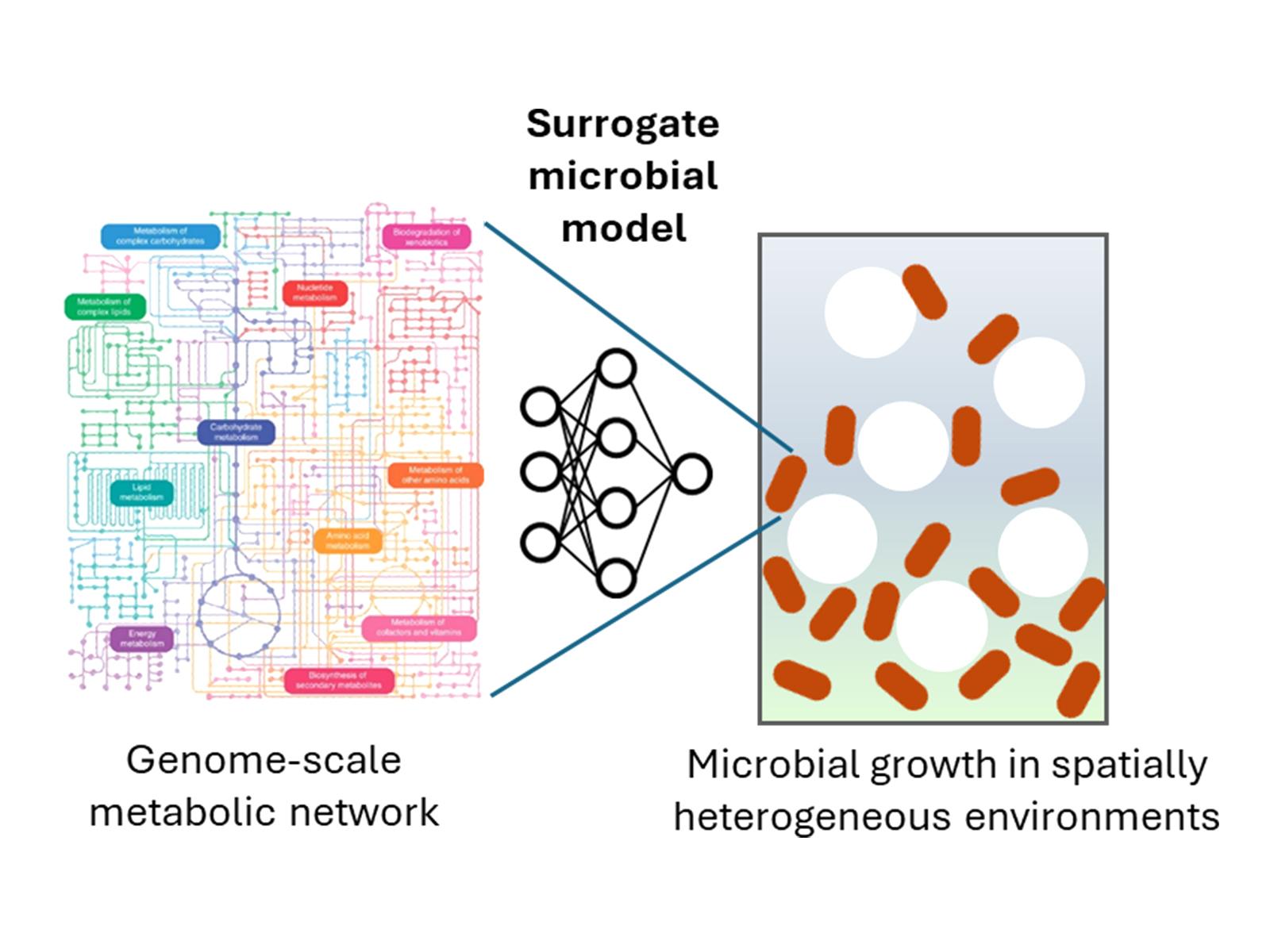
Harnessing the power of artificial intelligence allowed for the seamless integration of metabolic networks of microbial communities with reactive-transport models. These integrated models describe important biological and physical processes that occur across scales. Pretrained artificial neural networks serve as surrogate microbial models for direct incorporation into reactive-transport models. (Figure: Hyun-Seob Song | University of Nebraska–Lincoln)
<関連情報>
- https://www.pnnl.gov/publications/ai-powers-ability-represent-microbial-processes-ecosystem-models
- https://www.nature.com/articles/s41598-025-89997-9
機械学習による反応輸送モデリングとフラックスバランス解析の結合による、微生物代謝スイッチングの迅速かつ安定したシミュレーション Coupling flux balance analysis with reactive transport modeling through machine learning for rapid and stable simulation of microbial metabolic switching
Hyun-Seob Song,Firnaaz Ahamed,Joon-Yong Lee,Christopher S. Henry,Janaka N. Edirisinghe,William C. Nelson,Xingyuan Chen,J. David Moulton & Timothy D. Scheibe
Scientific Reports Published:19 February 2025
DOI:https://doi.org/10.1038/s41598-025-89997-9
Abstract
Integrating genome-scale metabolic networks with reactive transport models (RTMs) provides a detailed description of the dynamic changes in microbial growth and metabolism. Despite promising demonstrations in the past, computational inefficiency has been pointed out as a critical issue to overcome because it requires repeated application of linear programming (LP) to obtain flux balance analysis (FBA) solutions in every time step and spatial grid. To address this challenge, we propose a new simulation method where we train and validate artificial neural networks (ANNs) using randomly sampled FBA solutions and incorporate the resulting surrogate FBA model (represented as algebraic equations) into RTMs as source/sink terms. We demonstrate the efficiency of our method via a case study of Shewanella oneidensis MR-1. During aerobic growth on lactate, S. oneidensis produces metabolic byproducts (such as pyruvate and acetate), which are subsequently consumed as alternative carbon sources when the preferred nutrients are depleted. To effectively simulate these complex dynamics, we used a cybernetic approach that models metabolic switches as the outcome of dynamic competition among multiple growth options. In both zero-dimensional batch and one-dimensional column configurations, the ANN-based surrogate models achieved substantial reduction of computational time by several orders of magnitude compared to the original LP-based FBA models. Moreover, the ANN models produced robust solutions without any special measures to prevent numerical instability. These developments significantly promote our ability to utilize genome-scale networks in complex, multi-physics, and multi-dimensional ecosystem modeling.