2026-07-23 中国科学院(CAS)
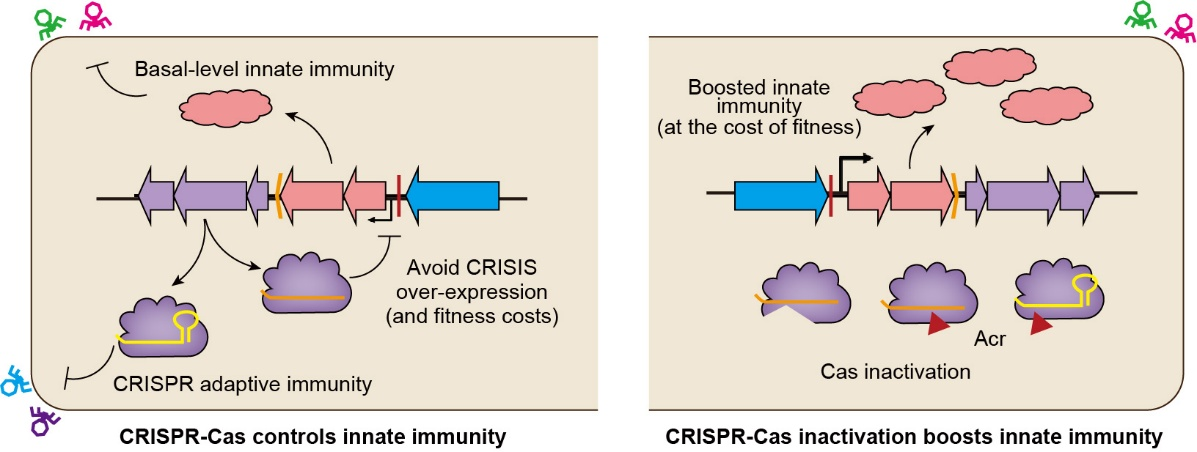
Model for layered bacterial defence orchestrated by CRISPR-Cas. (Image by Prof. LI Ming’s group)
<関連情報>
- https://english.cas.cn/newsroom/research-news/202607/t20260722_1178877.shtml
- https://www.nature.com/articles/s41586-026-10833-9
CRISPR-Casは、組み込み型抗ファージ防御システムの遺伝子発現を制御する CRISPR–Cas regulates expression of embedded anti-phage defence systems
Xian Shu,Rui Wang,Xufei Zhou,Feiyue Cheng,Jiayue Ma,Zhihua Li,Xin Li,Tuozhan Wu,Aici Wu,Qiong Xue,Chao Liu,Huiwei Zhao,Xifeng Cao,Lin Wang,Shouyue Zhang,Yan Zhang & Ming Li
Nature Published:22 July 2026
DOI:https://doi.org/10.1038/s41586-026-10833-9
Abstract
Bacteria utilize diverse defence systems to protect against harmful foreign DNA such as bacteriophages1,2, but how these systems coordinate with each other remains poorly understood. Here we uncover CRISIS (CRISPR-supervised immune system), a widespread regulatory paradigm whereby type I CRISPR–Cas loci embed and transcriptionally modulate diverse innate defences. Small non-canonical CRISPR RNA (crRNA)-like RNAs guide the I-C CRISPR-associated complex for antiviral defence (Cascade) effector complex to inhibit promoters of diverse immune cassettes—including composite multi-system clusters—enabling their basal expression for antiviral activity while mitigating fitness costs associated with hyperactivation, such as host growth impairment or exclusion of beneficial plasmids. When CRISPR–Cas is compromised by mutation or anti-CRISPR proteins, there is a burst in transcription of these embedded defence systems, leading to higher-level innate immunity at the expense of host fitness. Together, adaptive CRISPR–Cas systems orchestrate diverse innate immune systems into a layered defence network, comprising a prokaryotic ‘immunity guard’ strategy.