
2026-07-24 京都大学
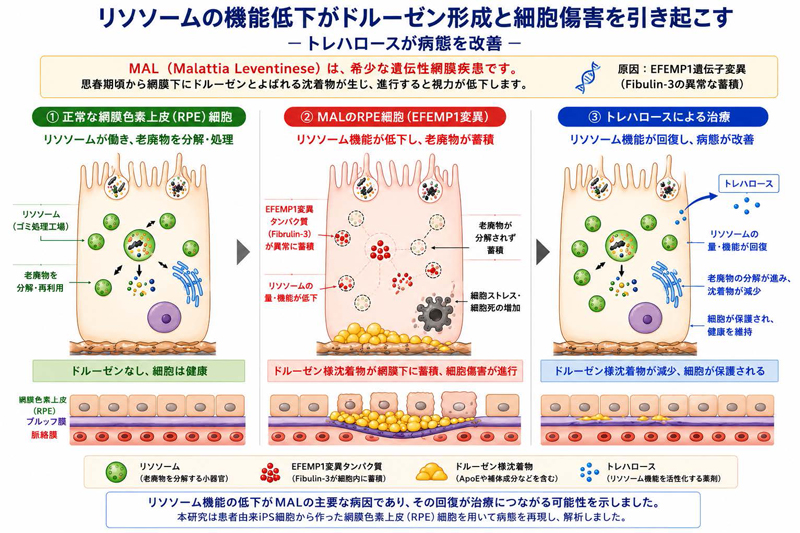
作成:池田華子、生成AI:OpenAI ChatGPT(GPT-5.5 Image Generation)
<関連情報>
- https://www.kyoto-u.ac.jp/ja/research-news/2026-07-24-0
- https://www.kyoto-u.ac.jp/sites/default/files/2026-07/web-2607-Ikeda-0e819ae748a9a0b875a100d596f7410f.pdf
- https://insight.jci.org/articles/view/194102
マラティア・レベンティネーゼにおけるリソソーム機能障害の回復は、ドルーゼン様沈着物の形成と細胞死を軽減する Restoration of impaired lysosomal function mitigates drusen-like deposit formation and cell death in Malattia Leventinese
Yumi Inoue, Hanako O. Ikeda, Masayuki Hata, Yuto Iida, Keiko Okamoto-Furuta, Isao Asaka, Makoto Arita, and Akitaka Tsujikawa
JCI Insight Published: July 22, 2026
DOI:https://doi.org/10.1172/jci.insight.194102
Abstract
Malattia Leventinese (MAL) is an inherited macular degeneration disorder characterized by retinal drusen formation in adolescence, leading to vision loss. A mutation in the fibulin-3 gene (EFEMP1) causes MAL; however, the mechanisms underlying disease onset and drusen formation remain unclear. In this study, we generated induced pluripotent stem cell–derived retinal pigment epithelial (iPSC-RPE) cells from a patient with MAL to investigate disease mechanisms and potential therapies. MAL iPSC-RPE exhibited fibulin-3 and apolipoprotein E (ApoE) aggregation, increased endoplasmic reticulum stress, and enhanced apoptosis. Long-term culture with photoreceptor outer segments led to drusen-like deposits containing ApoE, complement components, and collagen IV accumulation, and it showed activation of matrix metalloproteinase-2 (MMP2). Untargeted lipid analysis revealed increased hexosylceramide and bis-monoacylglycerophosphate levels in MAL iPSC-RPE cells. A key pathological feature was lysosomal dysfunction associated with altered regulation of lysosomal gene programs, including reduced transcription factor EB transcript levels. Treatment with trehalose, a lysosome-modulating compound, increased lysosomal content and function, reducing drusen-like deposit formation, inhibiting MMP2 activation, and suppressing apoptosis. This study highlighted lysosomal dysfunction as a contributor to RPE damage, drusen-like deposit accumulation, and extracellular matrix degradation. Pharmacological restoration of lysosomal function alleviated these defects, suggesting therapeutic potential for MAL and other drusen-related diseases, including age-related macular degeneration.
