2026-08-05 ミュンヘン大学(LMU)
<関連情報>
- https://www.lmu.de/en/newsroom/news-overview/news/revealed-mitochondria-act-as-sensors-for-essential-iron-molecule-06eddbee.html
- https://www.nature.com/articles/s41586-026-10885-x
古代のミトコンドリアプログラムがヘムの利用可能性に応じて翻訳を調整する An ancient mitochondrial program tunes translation to haem availability
Xiang Zhang,Max-Hinderk Schuler,Gonca Çetin,Eva-Maria Eckl,Lara Rheinemann,Julia Mergner,Barbara Steigenberger,Andreas Pichlmair & Lucas T. Jae
Nature Published:05 August 2026
DOI:https://doi.org/10.1038/s41586-026-10885-x
Abstract
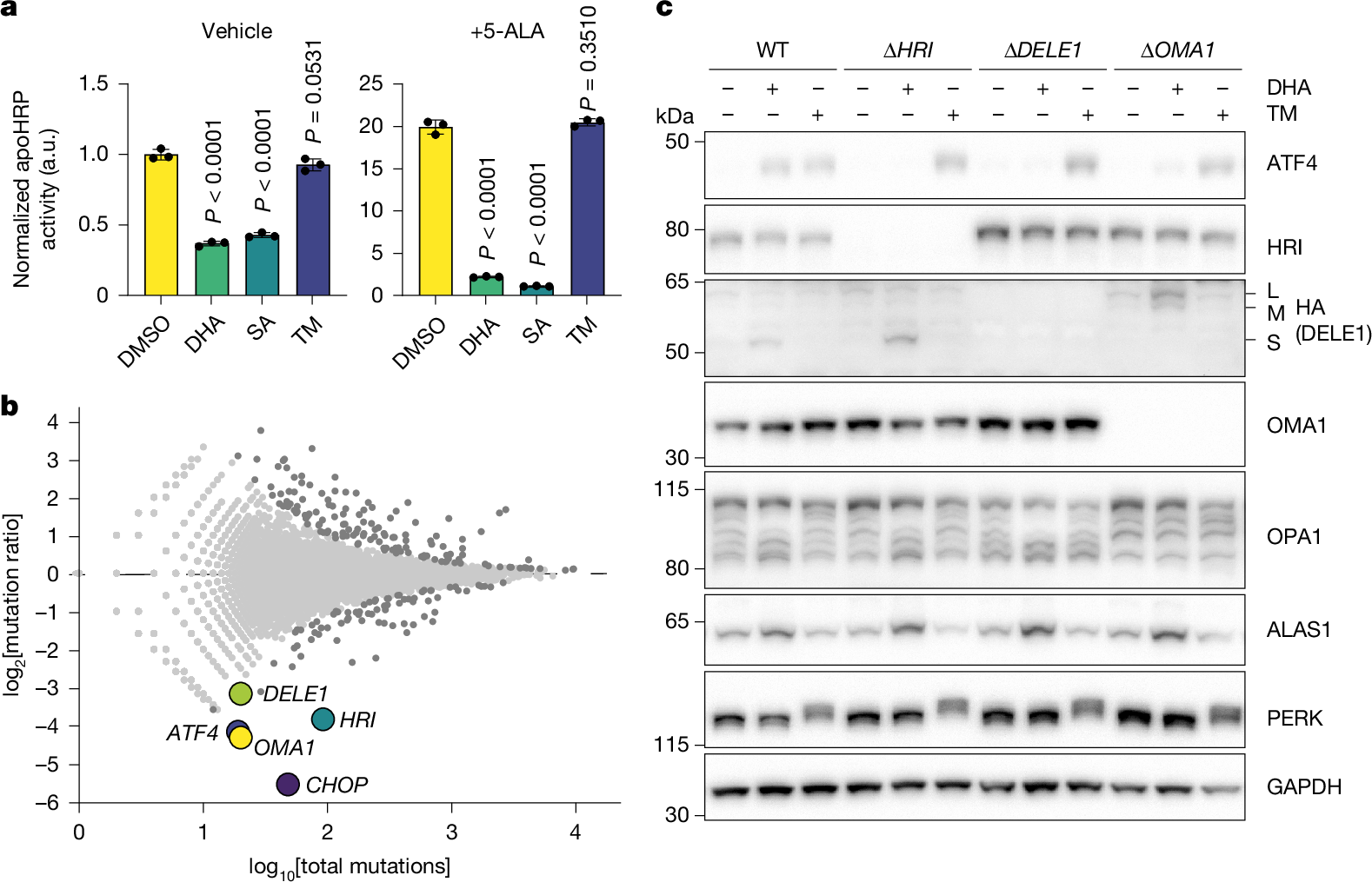
Anaemia is a major global health burden that affects one-quarter of the human population and annually accounts for over 50 million years of healthy life lost1. It arises from nutritional iron deficiency, hereditary disorders (including thalassaemia and sickle cell disease) and malaria, and is characterized by haemoglobin imbalances2. Haem—the active component of haemoglobin—is both essential and potentially toxic, which necessitates tight control of levels. However, the molecular circuitry that monitors haem levels remains obscure. The cytosolic eIF2α kinase HRI counteracts anaemia amid iron deficiency or thalassaemia3,4 by acting as a gatekeeper of translation during erythroid differentiation, which has been attributed to its haem-binding ability5. Here we uncover that haem scarcity is sensed inside mitochondria through an OMA1–DELE1 axis. Mechanistically, haem deficiency triggers OMA1-dependent mitochondrial release of DELE1. In the cytosol, DELE1 releases inhibitory haem from HRI, which enables modifications in a crucial disordered segment of the kinase. We demonstrate that this sensor–actuator operates across human tissues, including erythroid progenitors, and is evolutionarily conserved down to bloodless invertebrates, thus predating the emergence of haemoglobin-based oxygen transport. Notably, pharmacological manipulation of this system enhances fetal globin expression—a central therapeutic objective in haemoglobinopathies. Together, these results reveal a primordial sentinel system that safeguards against haem-related toxicity from the single-cell to the organismic scale.