2026-08-31 カロリンスカ研究所(KI)
<関連情報>
- https://news.ki.se/disease-patterns-may-guide-lifestyle-interventions-in-older-adults
- https://www.nature.com/articles/s43587-026-01188-x
SPRINTT試験から得られた、複数の疾患が併存するパターンが虚弱な高齢者の移動障害予防に及ぼす影響 Multimorbidity patterns influence mobility disability prevention in frail older adults from the SPRINTT trial
Davide Liborio Vetrano,Caterina Gregorio,Federico Triolo,Luca Soraci,Antonio Cherubini,Matteo Tosato,Stephan von Haehling,Emanuele Marzetti,Francesco Landi & Riccardo Calvani
Nature Aging Published:31 August 2026
DOI:https://doi.org/10.1038/s43587-026-01188-x
Abstract
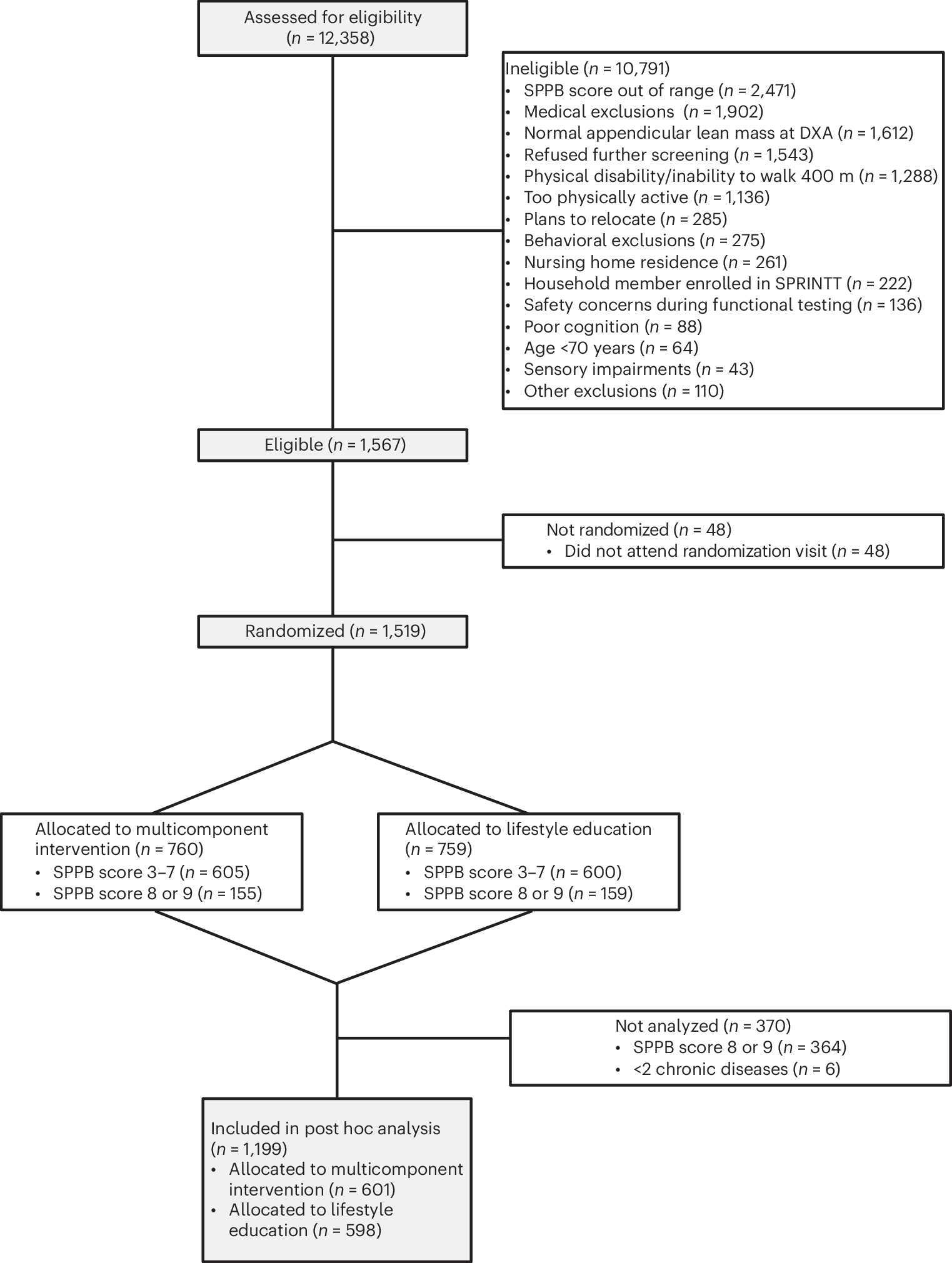
Preserving independence in older adults is a public health priority. Lifestyle interventions can prevent physical disability, but whether their efficacy is influenced by multimorbidity profiles is unclear. In this post hoc analysis of the SPRINTT randomized trial (NCT02582138), we investigated whether the efficacy of a multicomponent intervention (physical activity with technological support and nutritional counseling) differed across multimorbidity patterns. We included 1,199 community-dwelling adults aged ≥70 years with frailty, sarcopenia and two or more chronic conditions. Latent class analysis identified four multimorbidity patterns: unspecific (55%), psychiatric (24%), cardiometabolic (13%) and respiratory (7%). The intervention reduced the overall risk of mobility disability or death (hazard ratio (HR) 0.78, 95% confidence interval (CI) 0.66–0.92). In subgroup analyses, a significant benefit was observed in participants with a psychiatric multimorbidity pattern (HR 0.65, 95% CI 0.47–0.92). Bayesian partial pooling analyses also supported a beneficial effect in the unspecific pattern (HR 0.80, 95% credible interval 0.69–0.93), while estimates for the cardiometabolic and respiratory patterns were imprecise and not statistically significant. The intervention increased the event-free probability at 24 and 36 months and extended the time free from mobility disability or death by 2.09 months overall. Gains were 3.09 months in the psychiatric pattern and 1.99 months in the unspecific pattern, with no meaningful differences observed in the cardiometabolic and respiratory patterns. These findings suggest that the composition of multimorbidity may influence responsiveness to lifestyle interventions and that stratification based on disease patterns could improve the targeting and effectiveness of preventive strategies in older adults.