
2026-09-03 中国科学院(CAS)
<関連情報>
- https://english.cas.cn/newsroom/cas-in-media/202609/t20260903_1192554.shtml
- https://www.nature.com/articles/s43587-026-01180-5
大規模なヒト表現型データに基づく性別特異的な老化時計は、明確な老化の移行と循環シグネチャーを明らかにする Sex-specific aging clocks from a large-scale human phenome reveal distinct aging transitions and circulating signatures
Jiaming Li,Dan-Dan Gao,Jing Li,Lei Cao,Yuanyuan Du,Muzhao Xiong,Xi Chu,Wan Lei,Wei-Dong Ye,Gang Xu,Lina Ma,Jiazhen Tang,Qing Fu,Zikai Zheng,Hongkai Zhao,Ming Yi,Chunyu Lan,Liu-Jun Xu,Yanling Fan,Guohua Zhu,Liwen Xiao,Quan Zheng,Sicong Si,Huabiao Cheng,… Weiqi Zhang
Nature Aging Published:25 August 2026
DOI:https://doi.org/10.1038/s43587-026-01180-5
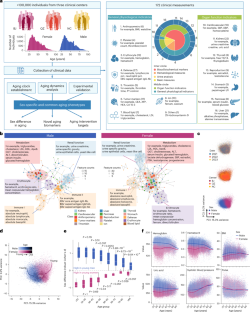
Abstract
Aging is a primary risk factor for chronic diseases, yet its progression varies among individuals and between sexes. Here, under the X-Age Project, we profiled the clinical aging phenome of the Multicentric Chinese Aging Study (mCAS) through a cross-sectional analysis of 172 clinical measures from more than 100,000 participants aged 18–98 years across three centers. These profiles enabled sex-specific clinical aging clocks that revealed divergent aging trajectories between women and men during midlife that converged in later life. Phenome-wide analyses revealed age-related accumulation of metabolic factors, including low-density lipoprotein, triglycerides, glucose and uric acid, and tumor markers, such as carcinoembryonic antigen and human epithelial protein 4. These age-accumulating factors induced senescence-related phenotypes in human endothelial cells. Furthermore, a high-fat diet mouse model with dietary reversal supported the modifiability of metabolic burden-induced aging. Together, this work establishes metabolic and tumor marker accumulation as actionable drivers of human aging, paving the way for personalized, sex-stratified geroprotective interventions.

