
2026-09-07 国立長寿医療研究センター
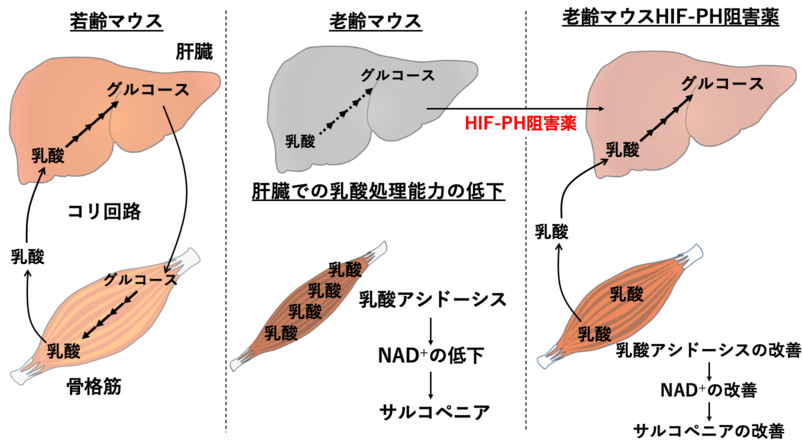
図1 本研究のまとめ図
<関連情報>
マウスにおいて、肝臓と筋肉の乳酸代謝障害は、骨格筋における乳酸アシドーシスを介してサルコペニアを引き起こす Impaired liver-muscle lactate metabolism causes sarcopenia via lactic acidosis in skeletal muscle in mice
Takahiro Eguchi, Nozomi Hayashiji, Sho Tabata, Keiko Kabetani, […] , and Naoki Ito
Science Advances Published:4 Sep 2026
DOI:https://doi.org/10.1126/sciadv.aeb4011
Abstract
Sarcopenia is a progressive disease characterized by age-related decline in skeletal muscle force and mass. The fundamental molecular pathogenesis of sarcopenia has not yet been elucidated. Here, we show that the accumulation of lactate and intracellular acidification, lactic acidosis, in skeletal muscle owing to impaired liver-skeletal muscle lactate metabolism is the fundamental cause of sarcopenia. Systemic lactate tolerance decreased in aged mice owing to the impaired lactate processing capacity in the liver, which caused lactic acidosis in skeletal muscle. Furthermore, pharmacological activation of hypoxia-inducible factor (HIF) or liver-specific activation of HIF1α improved age-associated impairment in lactate tolerance, lactic acidosis in skeletal muscle, and sarcopenia. Mechanistically, the decreased nicotinamide adenine dinucleotide level was the cause of dysregulated skeletal muscle functions due to lactic acidosis. Using mouse models, our results show lactic acidosis in skeletal muscle as a key molecular pathogenesis of sarcopenia and highlight HIF1α in the liver as a pharmacological target for sarcopenia.

