2026-09-07 合肥物質科学研究院(HFIPS)
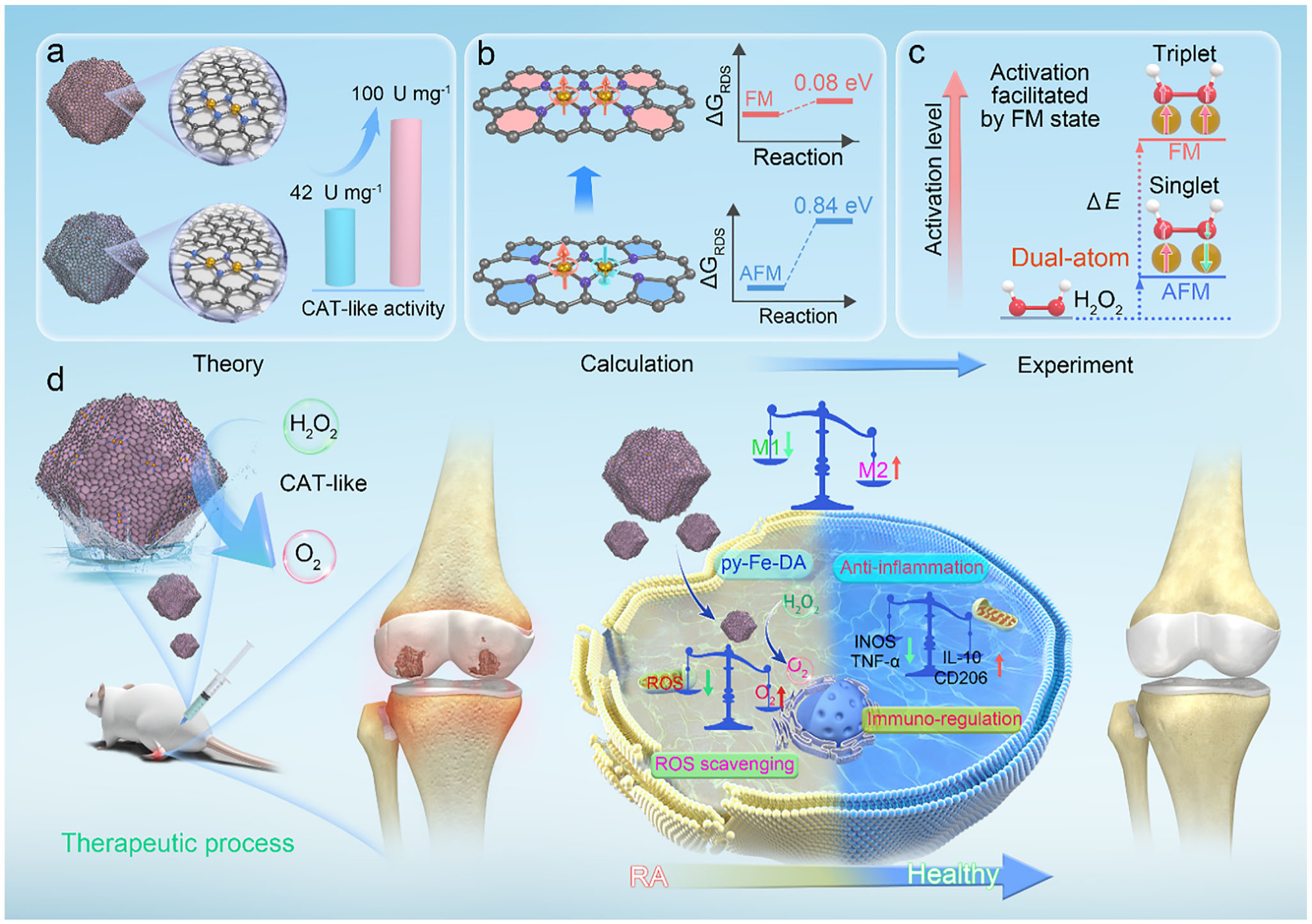
Schematic diagram of spin-regulated catalase-like catalysis of py-Fe-DA for rheumatoid arthritis therapy (Image by MENG Xiang)
<関連情報>
- https://english.hf.cas.cn/nr/bth/202609/t20260907_1192709.html
- https://onlinelibrary.wiley.com/doi/10.1002/anie.1653347
二原子ナノザイムにおける強磁性結合により、関節リウマチ治療のためのスピン有利なカタラーゼ様触媒作用が実現 Ferromagnetic Coupling in Dual-Atom Nanozymes Enables Spin-Favorable Catalase-Like Catalysis for Rheumatoid Arthritis Therapy
Xiangfu Meng, Ruofei Zhang, Luzheng Xu, Qilong Wang, Sijie Zhang, Kelong Fan, Xiangyang Li, Hui Wang
Angewandte Chemie International Edition Published: 05 August 2026
DOI:https://doi.org/10.1002/anie.1653347
ABSTRACT
Iron dual-atom (Fe DA) nanozymes, structurally analogous to natural catalase, exhibit promising catalase-like (CAT-like) activity, yet further improving their catalytic performance and elucidating the underlying mechanism remain major challenges. Herein, we developed a cascade strategy integrating vacancy induction and electrostatic adsorption to construct two representative Fe DA nanozymes, pr-Fe-DA and py-Fe-DA, with coordination environments dominated by pyrrolic-N and pyridinic-N, respectively. The resulting py-Fe-DA exhibits an exceptionally high CAT-like activity of 100 U mg−1, which is 2.4 times that of pr-Fe-DA (42 U mg−1), representing the highest value reported to date. Mechanistic studies and density functional theory calculations reveal that modulating the nitrogen coordination environment from pyrrolic-N to pyridinic-N promotes an antiferromagnetic-to-ferromagnetic transition in the magnetic coupling between Fe sites. This transition enables spin-favorable H2O2 activation through parallel spin alignment of the oxygen atoms in adsorbed H2O2, thereby accelerating O─H bond cleavage and O2 generation while decreasing the Gibbs free energy change of the rate-determining step from 0.84 to 0.08 eV. Moreover, py-Fe-DA effectively alleviates oxidative stress and inflammation in rheumatoid arthritis models. These findings identify magnetic coupling as a key descriptor of CAT-like activity and establish magnetic-coupling engineering as a powerful strategy for designing high-performance nanozymes.