2026-10-06 東北大学
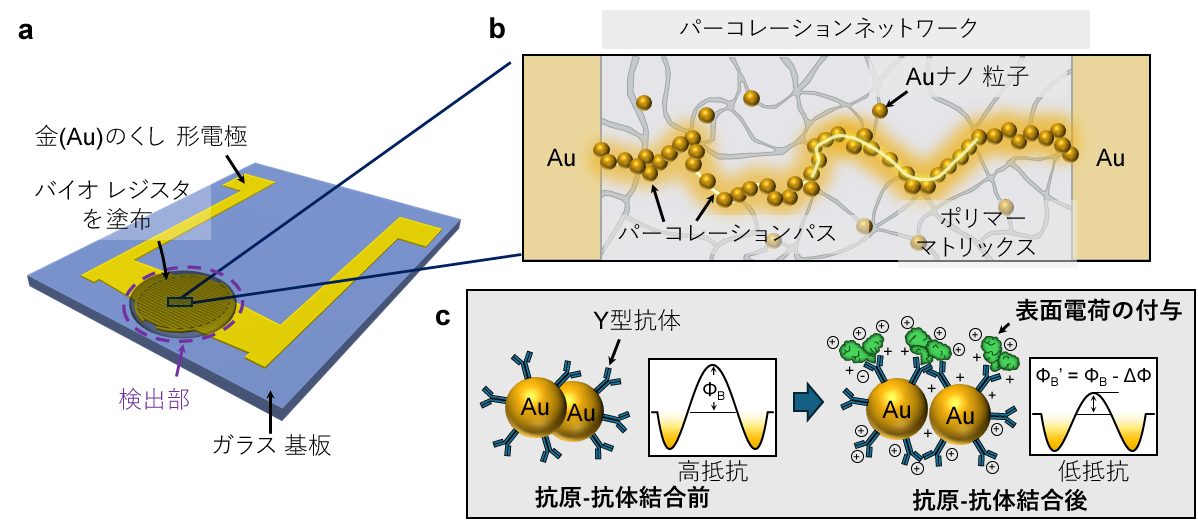
図1. 開発した抗体検出型抵抗変化バイオセンサの概要と動作原理。
<関連情報>
- https://www.tohoku.ac.jp/japanese/2026/10/press20261006-01-resistive.html
- https://www.nature.com/articles/s41378-026-01465-0
タンパク質バイオマーカー用抗体検出抵抗型バイオセンサー Antibody-detecting resistive biosensor for protein biomarkers
Yi-Hsiu Kao, Reo Takahashi, Nguyen Van Toan, Takaaki Abe, Ioana Voiculescu & Takahito Ono
Microsystems Nanoengineering Published:05 October 2026
DOI:https://doi.org/10.1038/s41378-026-01465-0
Abstract
Proteins serve as important biomarkers for clinical diagnostics, and a simple detection method for point-of-care applications is highly desirable. We developed an antibody-detecting resistive biosensor that utilizes a conductive network of gold (Au) nanoparticles for the detection of protein biomarkers. The proposed biosensor comprises two electrodes bridged by a functional film comprising Au nanoparticles, a polymer matrix, and target-specific antibodies, and the nanoparticle concentration is selected within an experimentally identified percolation transition region to achieve high sensitivity to small changes in resistance. In experiments, the electrical response of the proposed biosensor showed reliable concentration-dependent behavior, consistent with charge-mediated modulation of electron transport within the conductive network. When applied to detecting urinary growth differentiation factor-15 (GDF-15) as the target protein, the proposed biosensor exhibited a detection range of 23.4–1500 pg/mL and a fast response time of approximately 30 s, which would allow the tracking of dynamic changes in protein concentration. These results demonstrate that the proposed biosensor provides a simple and effective method for detecting various biomarkers in real time. The sensing concept may be extendable to other antigen–antibody systems, providing a potential general platform for biomolecular sensing.