2026-10-23 北海道大学,北海道教育大学
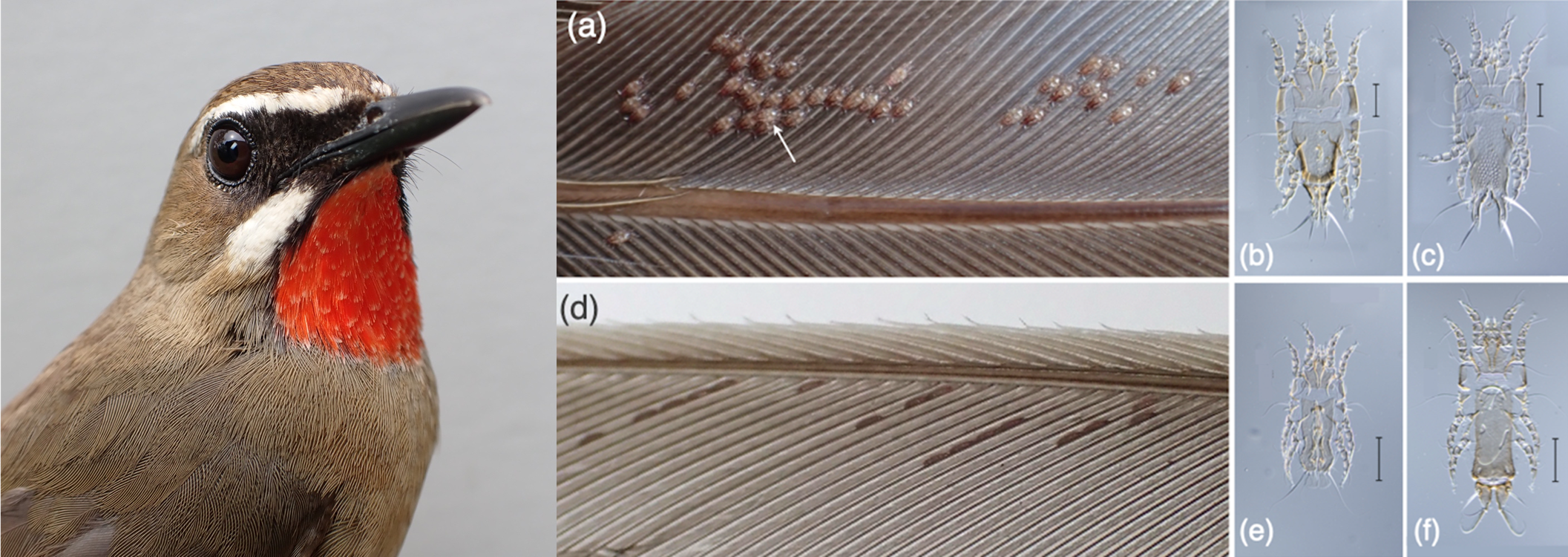
ノゴマCalliope calliopeとノゴマの羽に生息する2種類のウモウダニ分布の様子と顕微鏡写真
(a~c)羽の上面に分布するTrouessartia calliope
(d~f)羽の下面に分布するProctophyllodes sp.
<関連情報>
- https://www.hokudai.ac.jp/news/2026/10/post-2481.html
- https://link.springer.com/article/10.1007/s00114-026-02182-4
ウモウダニ群集における翼に沿った連続的かつ非対称な表裏の個体数の関係 Continuous and asymmetric dorsal–ventral abundance associations along the wing in feather mite communities
Masaoki Takagi, Miho Iwasaki, Naoya Yasuda, So Shiraiwa, Toru Katoh & Gen Takaku
The Science of Nature Published:20 October 2026
DOI:https://doi.org/10.1007/s00114-026-02182-4
Abstract
Feather mites are permanent ectosymbionts that occupy discrete feather microhabitats; however, little is known about how associations between dorsal and ventral taxa vary along continuous wing gradients. We examined feather-level spatial abundance associations between dorsal and ventral feather mites along the proximodistal axis of the wing in the Siberian Rubythroat (Calliope calliope) via nonlinear mixed-effects models. Dorsal feather mites (Trouessartia calliope) were largely absent from distal outer remiges (flight feathers) and increased toward proximal body-side remiges, whereas ventral feather mites (Proctophyllodes sp.) exhibited a positional gradient along the wing. When averaged across positions, the dorsal and ventral abundances showed only weak overall associations. However, position-specific analyses revealed that the dorsal–ventral slope was positive in distal outer remiges, declined toward mid-wing positions, and approached weakly negative values in the innermost secondaries. Because dorsal abundance was minimal distally, positive slopes in that region should not be interpreted as evidence of stable coexistence and may reflect responses to environmental constraints associated with distal wing positions. This position-dependent association was detected in breeding adult birds but not in juvenile birds, suggesting age-related differences in within-host spatial organization that may reflect the shorter time since mite transmission to juveniles and subsequent community assembly. Feather mite abundances were bilaterally symmetrical and showed no consistent effects of sex, date, or year, suggesting that host-level morphological stability provides a consistent spatial template for parasite organization. Together, these findings demonstrate that within-host feather mite assemblages exhibit spatially heterogeneous abundance associations along the wing, highlighting the importance of fine-scale spatial variation for understanding the organization and potential ecological relationships of cooccurring parasite taxa.