2026-10-26 東京科学大学
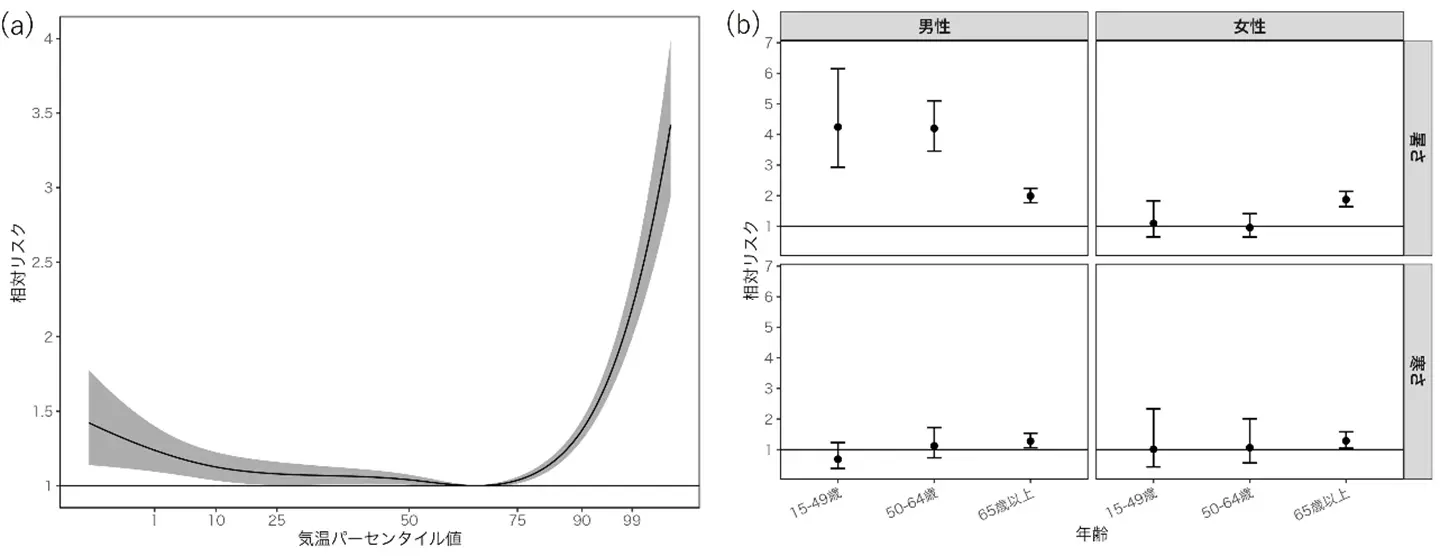
図1. (a)14日間のラグ効果を考慮した日平均気温パーセンタイルと気温と急性腎障害による緊急入院リスクとの関連。実線は各気温における相対リスクを示し、灰色は95%信頼区間を示す。
(b)極端な暑さ(各都道府県における1日の平均気温の上位1%に相当する気温)と極端な寒さ(各都道府県における1日の平均気温の下位1%に相当する気温)における、急性腎障害による入院リスク。黒丸は相対リスクを示し、実線は95%信頼区間を示す。
<関連情報>
気温と急性腎障害との関連性:日本における全国規模の時空間層別症例交差研究 Association between ambient temperature and acute kidney injury: a nationwide space-time-stratified case-crossover study in Japan
Aiperi Asanbek kyzy, Hisaaki Nishimura, Nobutoshi Nawa, Kiyohide Fushimi & Takeo Fujiwara
Journal of Exposure Science & Environmental Epidemiology Published:20 October 2026
DOI:https://doi.org/10.1038/s41370-026-00985-1
Abstract
Background
Acute kidney injury (AKI) is a severe condition characterized by a sudden decline of kidney function with a high mortality rate and healthcare costs. While extreme heat is a recognized risk factor for AKI, the effects of both heat and cold exposure across different demographics remain unclear.
Objective
To examine the association between ambient temperatures and AKI emergency hospitalizations, with a focus on age and sex differences.
Methods
Using a nationwide database, we identified 119,027 AKI emergency hospitalizations from 2011 to 2019. A space-time-stratified case-crossover study with conditional quasi-Poisson regression analysis was applied to estimate region-specific relative risk (RR) of AKI emergency hospitalization over lag days 0–13. Pooled RRs were calculated using random-effects meta-analysis. Analyses were stratified by age (younger, 15–49; middle-age, 50–64; and older, 65+ years old) and sex.
Results
Both extreme cold (first percentile) and heat (99th percentile) were associated with an increased risk of AKI emergency hospitalizations, with cumulative RRs of 1.24 (95% CI 1.09–1.40) and 2.21 (95% CI 2.00–2.43), respectively. Heat-related susceptibility was highest in younger (RR 4.24, 95% CI 2.93–6.15) and middle-aged men (RR 4.20, 95% CI 3.46–5.10), while in women it occurred in the older group (RR 1.87, 95% CI 1.64–2.14). Cold-related susceptibility was highest among older males (RR 1.28, 95% CI 1.06–1.53) and females (RR 1.29, 95% CI 1.04–1.58).
Significance
Extreme temperatures elevate AKI risk, with distinct age- and sex-specific vulnerability patterns. These findings highlight the need for targeted prevention strategies during temperature extremes, particularly protecting younger and middle-aged men from heat and older adults from cold exposure. Understanding the biological and social mechanisms underlying these demographic differences is essential for developing effective public health interventions in a changing climate
Impact statement
- This nationwide study reveals that both extreme heat and cold significantly increase acute kidney injury (AKI) emergency hospitalizations in Japan, with distinct age- and sex-specific vulnerability patterns. Younger and middle-aged men face a fourfold higher risk during heat exposure, while older adults of both sexes are most vulnerable to cold. These findings expand beyond heat-focused research and demonstrate the need for demographically targeted prevention strategies. As climate change intensifies temperature variability, these demographic-specific patterns highlight the need for tailored public health interventions to protect kidney health and reduce preventable AKI hospitalizations.