2026-10-26 東京科学大学
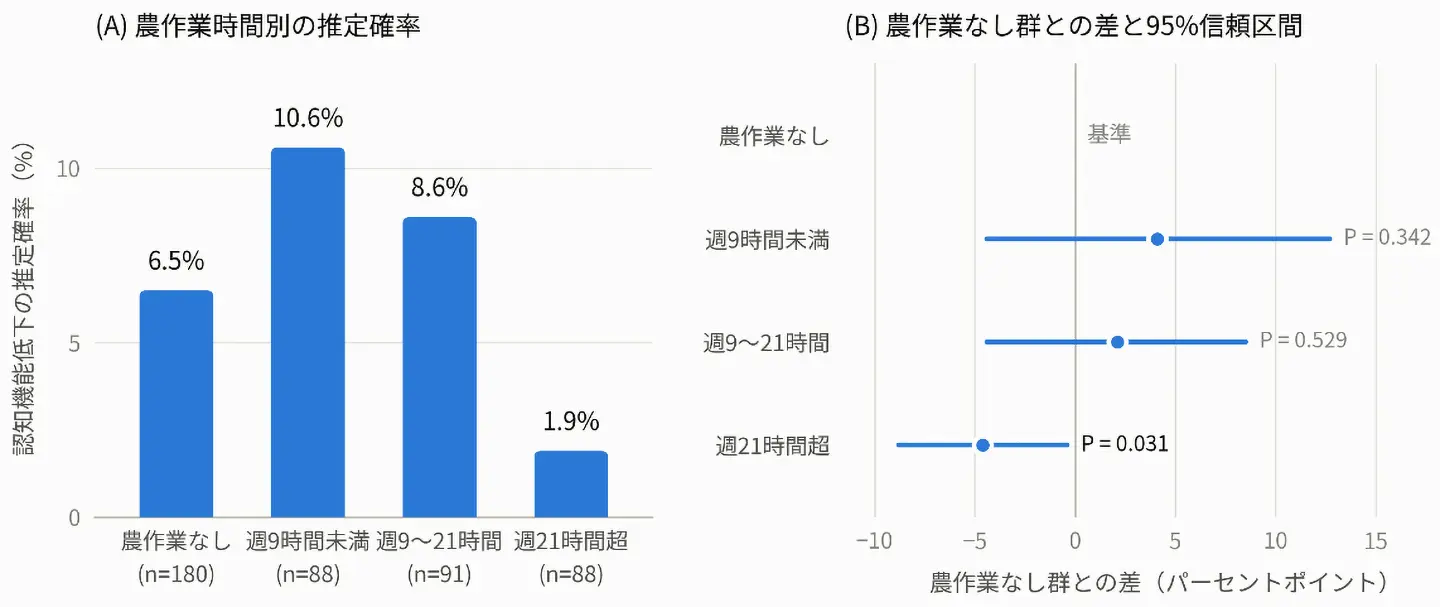
図1. 農作業時間別にみた認知機能低下の推定確率と農作業なし群との差
<関連情報>
- https://www.isct.ac.jp/ja/news/gfkf0vq4prfe
- https://link.springer.com/article/10.1007/s40520-026-03519-9
高齢者における農業、認知機能、および脳の局所容積の関連性:NEIGEコホート研究の結果 The association between farming, cognitive function, and regional brain volumes in older adults: results from the NEIGE cohort
Yuki Goto, Takeo Fujiwara, Ayako Morita, Hiroshi Murayama, Masaki Machida, Shigeru Inoue & Yugo Shobugawa
Aging Clinical and Experimental Research
DOI:https://doi.org/10.1007/s40520-026-03519-9 Early provide
Abstract
Background
The association between farming and cognitive decline remains controversial. This study examined the association of weekly farming hours with cognitive function and dementia-related brain volumes.
Methods
This cross-sectional study included 447 community-dwelling adults aged 65–84 years from the Neuron to Environmental Impact Across Generations Study in Japan. Participants were categorized by weekly farming hours: non-farming, < 9, 9–21, or 21 + hours/week. Low cognitive function was defined as a score of ≤ 23 on the Japanese version of the Mini-Mental State Examination (MMSE-J). Multivariable logistic regression was used for low cognitive function, as the primary outcome. Linear regression was used for continuous MMSE-J scores and dementia-related brain volumes. As an additional analysis, inverse-probability weighting was applied.
Results
Low cognitive function was present in 37 participants (8.3%). Farming for 21 + hours/week was associated with lower odds of low cognitive function than the non-farming group, adjusted for covariates (adjusted OR = 0.21; 95% CI: 0.05–0.93). Inverse-probability weighting showed that the estimated potential probability of low cognitive function was 6.5% and 1.9% for non-farming and 21 + hours/week farming, respectively, yielding an average treatment effect of − 4.6 percentage points (95% CI: −8.8 to − 0.4). However, farming hours were not significantly associated with continuous MMSE-J scores or dementia-related brain volumes.
Conclusions
Farming for 21 + hours/week was associated with lower odds of low cognitive function. However, this exploratory finding warrants cautious interpretation given the small number of events and inconsistent results across cognitive and neuroimaging outcomes. Longitudinal studies are needed to clarify temporality and causality.