2026-10-27 琉球大学
<関連情報>
有毒外来種への耐性の可能性を遺伝子から探る:島嶼生態系の保全に向けて Molecular Screening for Potential Resistance to Toxic Invasive Prey: Implications for Island Conservation
Alisa Tobe,Masako Izawa and Miho Inoue-Murayama
Genes Published: 15 October 2026
DOI:https://doi.org/10.3390/genes17101286
Abstract
Background/Objectives:
Invasive species can disrupt native predator–prey interactions, and toxic invasive prey may pose particular threats to native predators. The cane toad (Rhinella marina) secretes cardiotonic steroids (CTSs) that can cause lethal poisoning in predators. We reviewed the molecular basis and evolutionary patterns of CTS resistance and evaluated the potential and limitations of genetic screening for assessing wildlife vulnerability on Ishigaki-jima and Iriomote-jima Islands, Japan.
Methods:
We reviewed experimental, structural, and evolutionary evidence for CTS resistance associated with Na+/K+-ATPase α subunit (NKAα) and screened publicly available NKAα1 sequences from vertebrates occurring on the two islands, focusing on amino acid states previously associated with CTS target-site insensitivity.
Results:
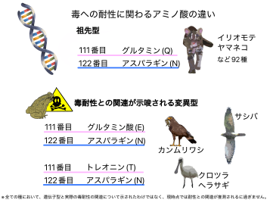
NKAα1 sequences were available for 96 of 185 native terrestrial vertebrate species. Most retained the putatively ancestral Q111/N122 combination, whereas alternative states at these major resistance-associated sites occurred in only a few species. These included T111/N122 in the black-faced spoonbill (Platalea minor), and E111/N122 in the crested serpent-eagle (Spilornis cheela perplexus) and grey-faced buzzard (Butastur indicus). T111 has shown context-dependent effects on CTS sensitivity in functional assays, whereas E111 has been proposed as a candidate resistance-associated state but lacks direct functional validation. The endangered Iriomote cat (Prionailurus bengalensis iriomotensis), an endemic predator that frequently consumes anurans, retained Q111/N122.
Conclusions:
NKAα1 sequence alone cannot establish whole-animal susceptibility or conservation risk because resistance may depend on sequence background, other NKAα paralogs, physiological mechanisms, and behavior. Molecular screening should therefore be viewed as an initial tool for identifying candidate molecular signatures and prioritizing species and knowledge gaps for subsequent functional, toxicological, and ecological investigation.