2026-10-27 東京科学大学
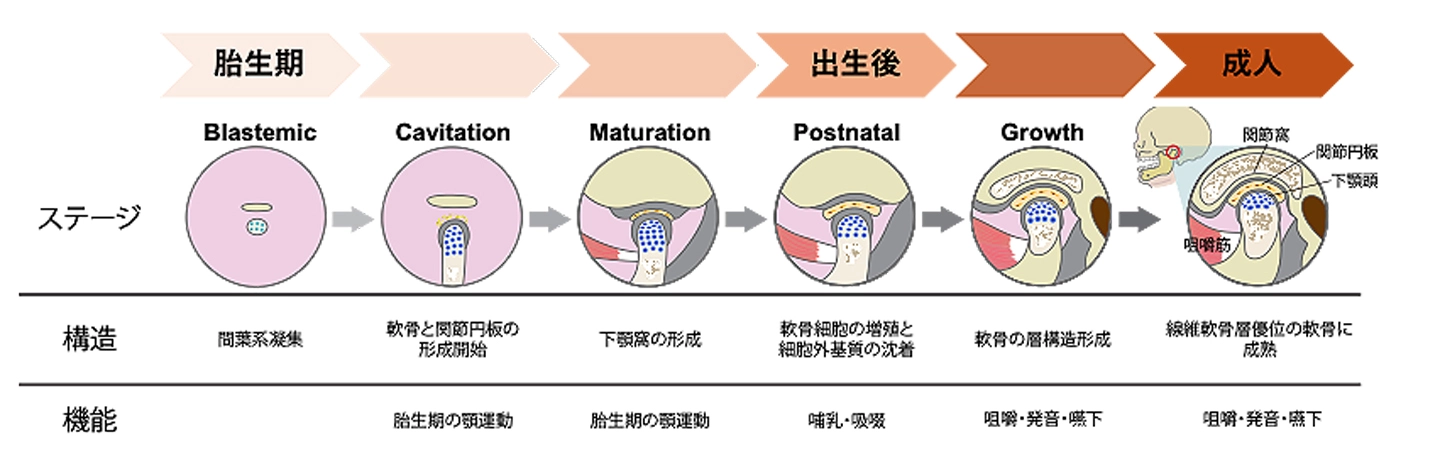
図1. ヒト顎関節の生涯にわたる変化と機能
<関連情報>
p75 NTRは、顎関節の発達と恒常性を維持するために、軟骨形成と機械的適応を調整する p75NTR orchestrates chondrogenesis and mechanoadaptation to preserve temporomandibular joint development and homeostasis
Chiho Kadota-Watanabe, Jinsook Suh, Eric Yin, Byron Zhao, Jey Kim, Yan Zhang, In-Won Chang, Sowmya Ramesh, Yuna Lee, […] , and Christine Hong
Science Advances Published:21 Oct 2026
DOI:https://doi.org/10.1126/sciadv.aef7786
Abstract
The temporomandibular joint (TMJ) is essential for oral functions such as chewing, speaking, and swallowing. Temporomandibular disorders that impair these functions notably reduce patients’ quality of life, and few therapeutic strategies are available to ameliorate these conditions. Here, we identify the neurotrophin receptor (p75NTR) as a central regulator of mandibular condylar cartilage development, mechanoadaptation, and homeostasis. p75NTR loss causes condylar and disc hypoplasia, reduced chondrocyte number, impaired load-induced anabolism, and accelerated degeneration. Conditional deletion experiments demonstrate chondrocyte-autonomous requirements for the brain-derived neurotrophic factor (BDNF)–p75NTR axis, which activates phosphoinositide 3-kinase AKT serine/threonine kinase and p38 mitogen-activated protein kinase signaling to promote proliferation and chondrogenic differentiation while restraining apoptosis. Degenerative human condyles exhibit reduced p75NTR expression levels. Together, these data establish p75NTR as a molecular hub integrating neurotrophic and mechanical cues to preserve postnatal TMJ architecture and highlight the BDNF-p75NTR axis as a potential therapeutic target.