2026-10-28 国立成育医療研究センター
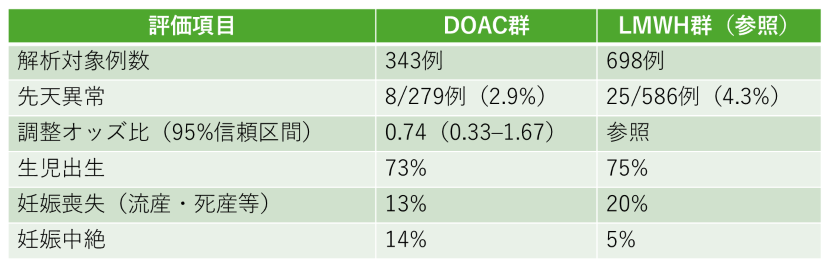
【表1:妊娠初期のDOAC ばく露群と低分子量ヘパリン(LMWH)ばく露群の比較】
<関連情報>
- https://www.ncchd.go.jp/press/2026/1028.html
- https://www.jthjournal.org/article/S1538-7836(26)00572-6/fulltext
妊娠初期の母体曝露後の直接経口抗凝固薬の生殖安全性:欧州催奇形性情報サービスネットワークによる比較コホート研究 Reproductive safety of direct oral anticoagulants after maternal exposure in early pregnancy: a comparative European Network of Teratology Information Services cohort study
Kim Dao ∙ Evelin Beck ∙ Veronique Pizzoglio-Billaudaz ∙ … ∙ Alice Panchaud ∙ Ursula Winterfeld1 ∙ Maria Hoeltzenbein
Journal of Thrombosis and Haemostasis Published:September 15, 2026
DOI:https://doi.org/10.1016/j.jtha.2026.08.037
Abstract
Background
Direct oral anticoagulants (DOACs) are increasingly prescribed to women of childbearing age, making inadvertent first-trimester exposure more likely.
Objectives
We prospectively evaluated the risks of major birth defects and pregnancy loss following first-trimester DOAC exposure.
Methods
We conducted a multicenter, observational prospective cohort study comparing pregnancy outcomes in women exposed to a DOAC during the first trimester of pregnancy and a reference group of women exposed to a low molecular weight heparin (LMWH) during the first trimester, between 2008 and 2024.
Results
A total of 343 DOAC-exposed and 698 LMWH-exposed pregnancies were included. DOAC exposure was not associated with an increased risk of major birth defects (DOAC n = 8/279, 2.9%; LMWH n = 25/586, 4.3%; adjusted odds ratio, 0.74; 95% CI, 0.33-1.67). In the cumulative incidence analysis (340 DOAC and 688 LMWH), the rates of live birth, pregnancy loss, and pregnancy termination were 73%, 13%, and 14% in the DOAC group and 75%, 20%, and 5% in the LMWH reference group. Cox proportional hazards cause-specific models indicated no increased risks for pregnancy loss after DOAC exposure, but a higher hazard of pregnancy termination.
Conclusions
First-trimester DOAC exposure was not associated with a substantially increased risk of major birth defects or pregnancy loss, and the observed defects did not suggest a teratogenic pattern, consistent with reported findings in the existing literature. These results offer further reassurance for counseling in case of inadvertent exposure. Larger studies are still warranted to validate these findings due to a limited sample size and window of exposure.