2026-10-29 合肥物質科学研究院(HFIPS)
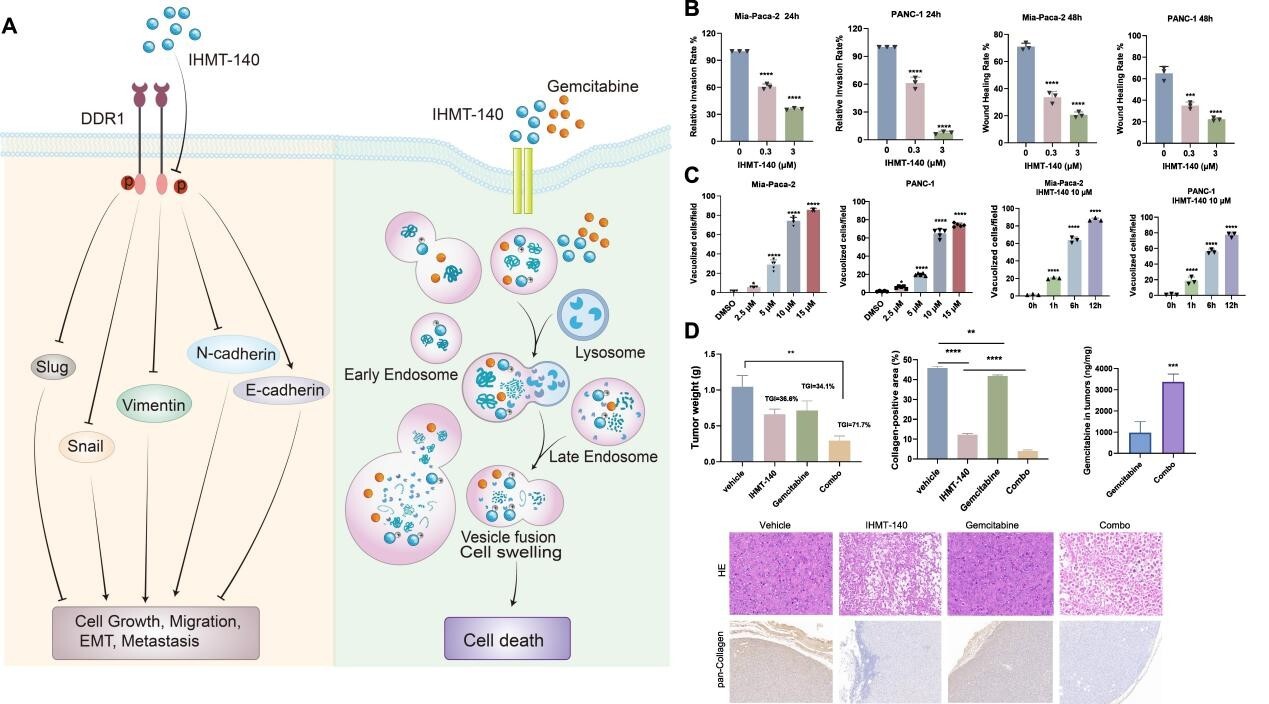
The dual mechanism of action and therapeutic effects of IHMT-140 in pancreatic cancer. (Image by WANG Beilei)
<関連情報>
- https://english.hf.cas.cn/nr/rn/202610/t20261029_1212787.html
- https://www.sciencedirect.com/science/article/pii/S2090123226005941
DDR1阻害とメトゥオーシス誘導という2つのメカニズムを介した膵臓癌治療薬としてのピラゾール誘導体IHMT-140の発見 Discovery of pyrazole derivative IHMT-140 as a pancreatic cancer therapeutic agent via dual mechanisms DDR1 inhibition and methuosis induction
Beilei Wang,Wenwen Ma, Fengming Zou,Xixiang Li, Qingwang,Chao Wu, Aoli Wangc,Li Wang, Jing Liu, Wenchao Wang, Qingsong Liu
Journal of Advanced Research Available online: 28 July 2026
DOI:https://doi.org/10.1016/j.jare.2026.07.049
Abstract
Introduction
Pancreatic cancer continues to be among the most lethal malignancies. The distinct tumor microenvironment (TME) not only facilitates tumor cell proliferation, invasion, and metastasis but also establishes a formidable barrier to the diffusion of chemotherapeutic agents and immunotherapies. Consequently, it is imperative to identify novel compounds that target the tumor microenvironment (TME).
Objectives
This study aims to identify a small molecule as a therapeutic agent for pancreatic cancer through dual mechanisms, specifically DDR1 inhibition and methuosis induction.
Methods
We characterized DDR1 as a primary target of N-(4-Methyl-3-(4-(5-(4-methylpiperazin-1-yl)pyridin-3-yl)-1H-pyrazol-1-yl)phenyl)-6-(trifluoromethyl)picolinamide (IHMT-140) using ADP-Glo assays, KINOMEscan, Western blotting, and molecular docking. Colony formation, invasion, wound-healing migration, and immunohistochemical staining assays demonstrated that IHMT-140 suppresses epithelial-mesenchymal transition (EMT) by regulating key EMT markers. Cell viability assays, including Cell Titer-Glo and live-cell imaging, transmission electron microscopy (TEM), and immunofluorescence staining, revealed that IHMT-140 triggers methuosis in pancreatic cancer cells. RNA-seq was also employed to confirm the underlying mechanisms. Finally, Cell Titer-Glo, Western blot, and flow cytometry were applied to demonstrate the combined antitumor effects of IHMT-140 and gemcitabine. Gemcitabine uptake and tumor accumulation were quantified by high-resolution mass spectrometry. The in vivo efficacy was tested in a xenograft model, with tumor sections analyzed by H&E and pan-collagen staining.
Results
We discovered N-(4-Methyl-3-(4-(5-(4-methylpiperazin-1-yl)pyridin-3-yl)-1H-pyrazol-1-yl)phenyl)-6-(trifluoromethyl)picolinamide (IHMT-140) as a novel dual-function agent that acts as a DDR1 inhibitor and a methuosis inducer. It simultaneously remodels the tumor stromal ECM and activates excessive macropinocytosis. Pharmacological evaluation shows that IHMT-140 inhibits tumor invasion and metastasis, enhances gemcitabine accumulation in tumors, and significantly improves therapeutic outcomes.
Conclusion
Our findings present a promising therapeutic strategy for pancreatic cancer, integrating DDR1 kinase inhibition with methuosis induction to augment chemotherapy efficacy. This approach provides a potential novel approach for pancreatic cancer therapy.