
2026-11-03 中国科学院(CAS)
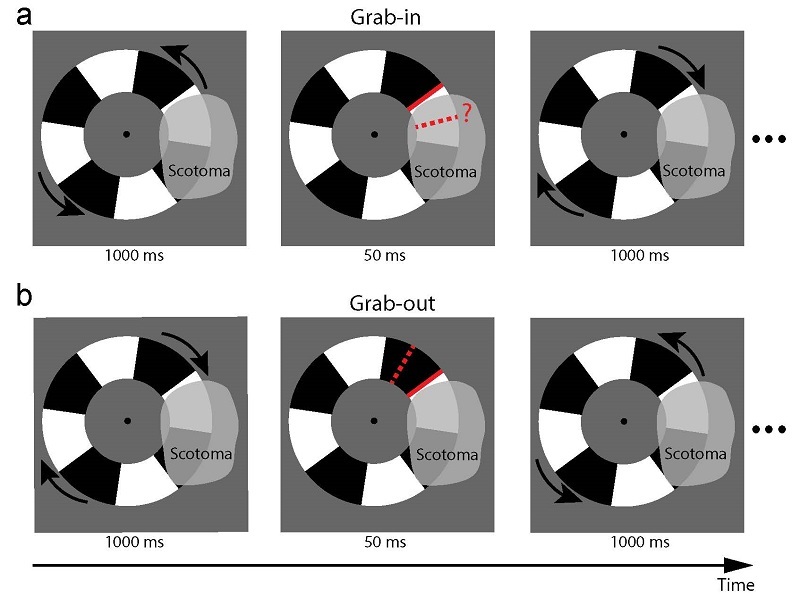
Schematic of flash position shifts under Grab-in and Grab-out conditions. (Image by ZHANG Peng’s group)
<関連情報>
- https://english.cas.cn/newsroom/research-news/202611/t20261103_1213052.shtml
- https://www.sciencedirect.com/science/article/pii/S3117990826000034
運動外挿知覚には、フィードバック信号を表現するための健全な一次視覚野が必要である Intact primary visual cortex to express the feedback signals is necessary for motion-extrapolated perception
Jiahan Hui , Patrick Cavanagh , Alex O. Holcombe , Chencan Qian , Sheng He , Huanfen Zhou , Peng Zhang
Cognitive Science Research Available online: 8 October 2026
DOI:https://doi.org/10.1016/j.csres.2026.09.002
Abstract
The role of the primary visual cortex (V1) in conscious visual perception remains highly controversial. By examining a visual illusion known as the flash-grab effect (FGE) in cortical blindness patients, we investigated whether an intact V1 is necessary for motion-extrapolated perception. A bar was flashed just outside the scotoma in the intact visual field, followed by a background motion reversal either toward or away from the scotoma. Patients with V1 lesions exhibited a striking dissociation: when the motion reversed away from the scotoma, the flash was perceived as strongly shifted into the intact field; however, when the motion reversed toward the scotoma, the flash was not seen, presumably because the displaced feedback signal could not reach the lesioned part of V1. In contrast, patients with optic radiation damage but intact visual cortex clearly experienced the displaced flash within their blind field. Finally, healthy participants also perceived the flash as shifted inside an artificial, on-screen scotoma, although with a smaller effect size. Together, these findings provide causal evidence that an intact V1, able to receive feedback from higher cortex, is necessary to generate conscious position perception.

