2026-04-27 中国科学院武漢植物園
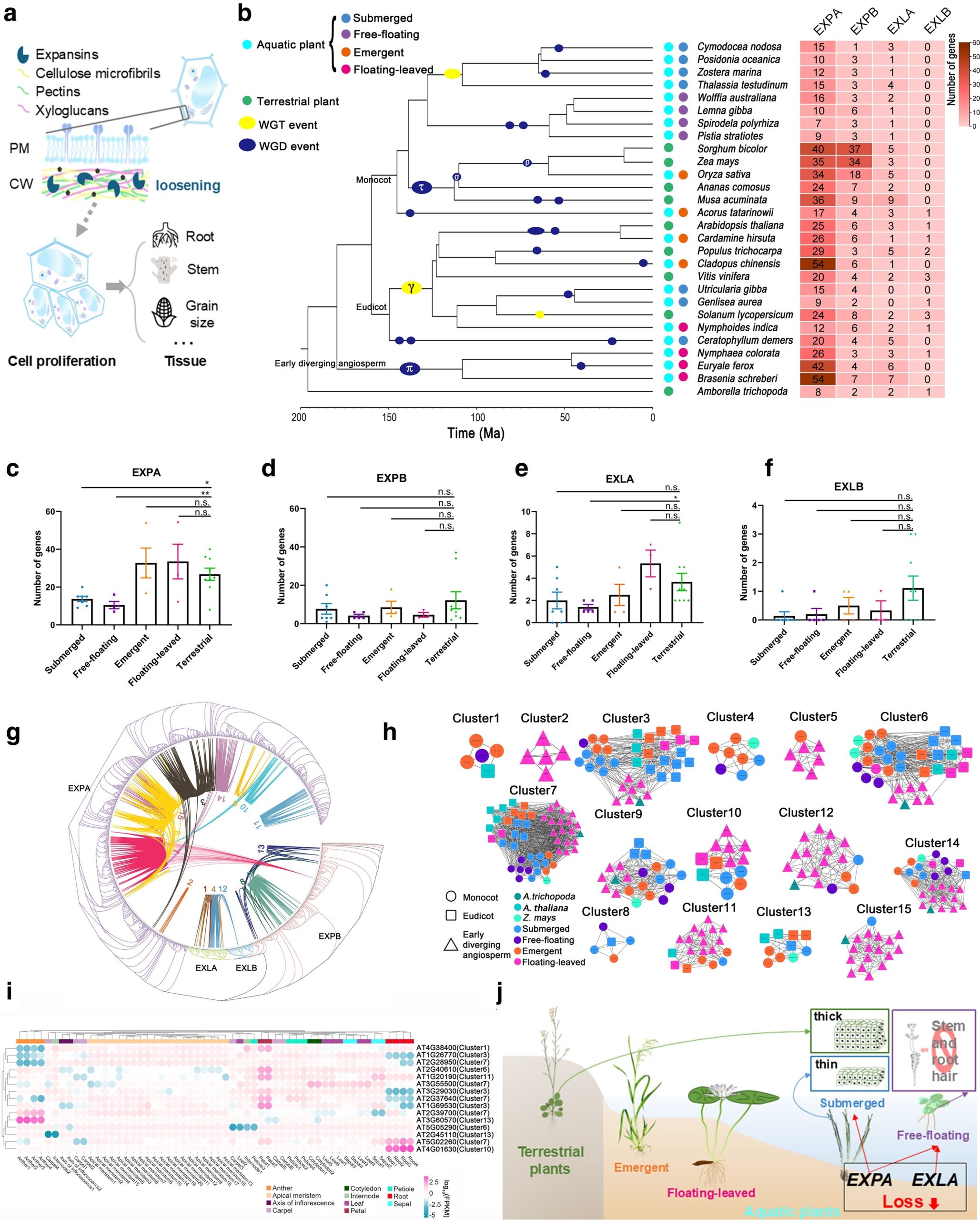
Phylogenetic investigation and synteny network-based clusters of expansin gene families in aquatic angiosperms (Image by WBG)
<関連情報>
- http://english.wbg.cas.cn/rh/rp/202604/t20260427_1157974.html
- https://academic.oup.com/plphys/article-abstract/200/3/kiag113/8527285
水生植物における機械器官の単純化は、エクスパンシン遺伝子の喪失と関連している Simplified mechanical organs in aquatic plants are associated with the loss of expansin genes
Yue Zhang ,Yves Van de Peer ,Zhen Li ,Kathleen Marchal ,Jinming Chen
Plant Physiology Published:18 March 2026
DOI:https://doi.org/10.1093/plphys/kiag113
Extract
Dear Editor,
Aquatic plants have evolved multiple times independently within angiosperms and can be categorized into 4 main life forms: free-floating, submerged, floating-leaved, and emergent (Koga et al. 2024). The transition of angiosperms from land back to water required specific adaptations to cope with the variable conditions of aquatic environments (Sculthorpe 1967; Park et al. 2021; Koga et al. 2024). Continuous fluctuations in aquatic environments, driven by Earth–Moon tidal forces and the inherent inertial forces of water bodies, might have been harsh for the ancestors of aquatic angiosperms when they started invading waters, as their tissues were pliable and prone to deformation (Puijalon et al. 2008). Rather than forming stronger tissues, aquatic plants adapted a way to reduce water flow resistance. Specifically, root systems of free-floating aquatic plants have been simplified, and submerged leaves are devoid of palisade and spongy tissues, leading to thinner leaf structures (Park et al. 2021; Wang et al. 2022). The origin of this adaptation to aquatic environments has previously been associated with gene loss (Ma et al. 2024; Guo et al. 2025). Particularly relevant in this context is the association of loss of members of the expansin (EXP) gene family to the presence of less complex cellular structures in aquatic plants, as suggested by Hepler et al. (2020), based on a phylogenetic analysis of a restricted number of plant genomes, including 3 aquatic plants and the terrestrial model plants Arabidopsis thaliana and Oryza sativa. Expansins are cell wall proteins that non-enzymatically disrupt the non-covalent interaction between cellulose microfibrils and matrix polysaccharides (such as pectins and xyloglucans), thereby loosening the cell wall to facilitate irreversible cell wall expansion without compromising tensile strength (Fig. 1a) (Choi et al. 2003). EXP plays a crucial role during plant tissue morphogenesis and the regulation of cell wall expansion during cell proliferation and differentiation (Boron et al. 2015; Samalova et al. 2023). To revisit the role of the expansins in the adaptation toward aquatic conditions, we performed a more comprehensive phylogenetic analysis of the same gene family relying on 19 aquatic plant genomes, representatively sampled from the 4 aquatic life forms, associated with hygrophilous to fully submerged aquatic environments.