2026-04-28 中国科学院(CAS)
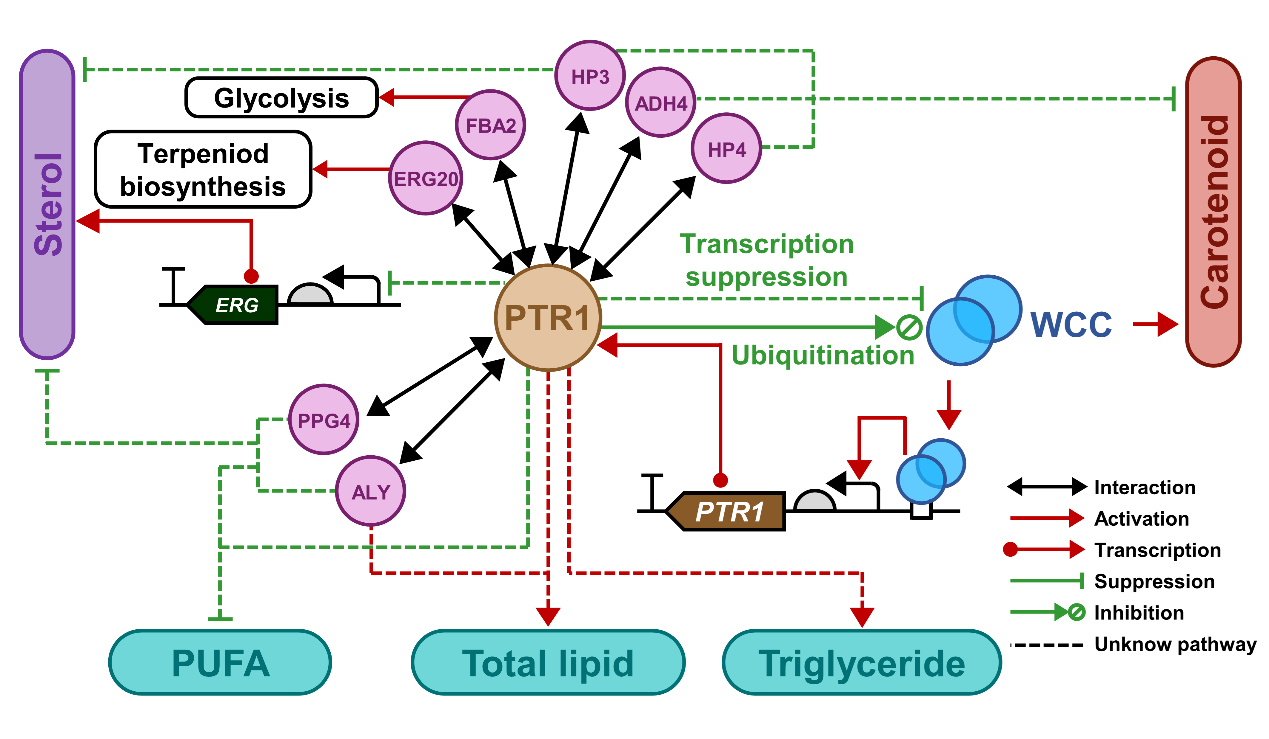
Proposed model for PTR1-mediated regulation of carotenoid, sterol, and lipid metabolism. (Image by HUANG Ruilin)
<関連情報>
- https://english.cas.cn/newsroom/research-news/202604/t20260428_1158214.shtml
- https://www.pnas.org/doi/10.1073/pnas.2530496123
保存されたE3ユビキチンリガーゼがXanthophyllomyces dendrorhousにおけるカロテノイド、ステロール、および脂質代謝を再構築する A conserved E3 ubiquitin ligase rewires carotenoid, sterol, and lipid metabolism in Xanthophyllomyces dendrorhous
Ruilin Huang, Jiurong Wang, Ruirui Ding, +7 , and Shi’an Wang
Proceedings of the National Academy of Sciences Published:April 24, 2026
DOI:https://doi.org/10.1073/pnas.2530496123
Significance
Eukaryotic cells must balance the biosynthesis of sterols, lipids, and in many organisms, carotenoids, which draw on shared acetyl-CoA-derived precursors. Our study identifies the ubiquitin ligase PTR1 as a regulator that coordinates these pathways in Xanthophyllomycesdendrorhous through a reciprocal regulatory loop with the White Collar Complex. This ubiquitin-dependent mechanism provides insight into how protein ubiquitination couples protein modification to metabolic homeostasis in X. dendrorhous, suggesting a broader principle of cellular adaptation to metabolic resource constraints and offering broad avenues for rationally engineering eukaryotic production platforms.
Abstract
Sterols, lipids, and carotenoids are major metabolites that share common biosynthetic precursors and underpin key physiological processes in eukaryotes. Yet, how cells coordinate metabolic flux through these competing pathways to maintain homeostasis remains unclear. Here, we identify a conserved RING-type E3 ubiquitin ligase, PTR1, as a central regulatory hub that orchestrates the interplay among these pathways in the yeast Xanthophyllomyces dendrorhous. Disruption of PTR1 triggers a concerted metabolic rewiring that enhances astaxanthin and sterol biosynthesis while shifting fatty acid composition toward polyunsaturation. Integrated multiomics and protein interaction analyses suggest that PTR1 targets White Collar 1 (WC1) for ubiquitination, establishing a reciprocal regulatory loop that maintains carotenoid homeostasis. Beyond WC1, PTR1 interfaces with a broader metabolic network to fine-tune central metabolism through discrete regulatory nodes. Notably, PTR1 homologs are found across evolutionarily distant eukaryotic lineages, including fungi, algae, plants, and animals, highlighting deep evolutionary conservation of the underlying protein architecture. These findings uncover a mechanism by which protein ubiquitination contributes to the coordination of distinct yet interconnected biosynthetic pathways in X. dendrorhous and point to the potential broader relevance of ubiquitin-mediated metabolic coordination beyond this species.