2026-05-20 産業技術総合研究所
<関連情報>
- https://www.aist.go.jp/aist_j/press_release/pr2026/pr20260520/pr20260520.html
- https://pubs.acs.org/doi/10.1021/jacs.6c02267
ヒストンアセチル化部位と末端との近接性がDNAとの相挙動を左右する Proximity of the Histone-Acetylation Site to the Termini Shapes Phase Behavior with DNA
Masahiro Mimura,Hiroka Sugai,Tomoshi Kameda,Ryo Kitahara,Soichiro Kitazawa,Yoichi Shinkai,Sayaka Ishihara,Ryoji Kurita,and Shunsuke Tomita
Journal of the American Chemical Society Published: May 7, 2026
DOI:https://doi.org/10.1021/jacs.6c02267
Abstract
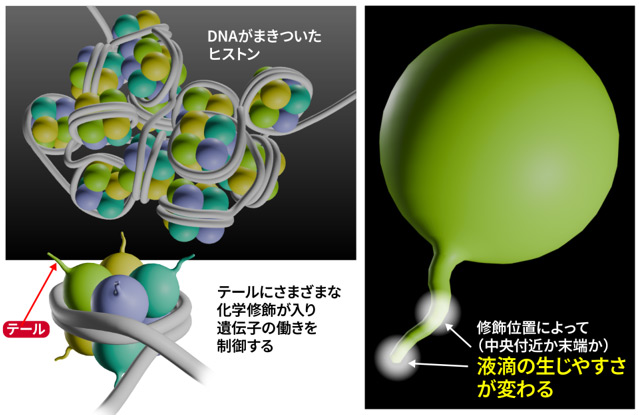
Post-translational modifications (PTMs) of histones play a pivotal role in chromatin condensation, with increasingly more evidence pointing to the involvement of liquid–liquid phase separation (LLPS). Here, we report the significant impact of the acetylation site of the N-terminal histone H3 peptide on LLPS with nucleosomal-linker DNA. In our model system, wherein the synthesized H3 peptide and DNA undergo LLPS, acetylation of the H3 peptide significantly inhibits LLPS, with the effects varying markedly depending on the acetylation site; acetylation near the H3 peptide end more strongly inhibits LLPS than acetylation near the H3 peptide center. Through experiments and molecular dynamics (MD) simulations, we show that this phenomenon arises from multiple contributing factors, including differences in the thermal stability of DNA, hydrophobic effects, and charge distribution within the H3 peptide/DNA complexes, which together promote the formation of intercomplex networks. Our findings not only provide fundamental insights that link LLPS-mediated chromatin condensation to biological phenomena depending on the acetylation sites but also suggest novel avenues for site-specific chemical modulation to regulate LLPS, which may, in turn, inspire new strategies in biotechnological applications and materials design.