2026-06-08 中国科学院(CAS)
<関連情報>
- http://english.genetics.cas.cn/news_/researchnews/202606/t20260608_1161377.html
- https://www.cell.com/molecular-plant/abstract/S1674-2052(26)00186-3
根圏細菌β-グルコシダーゼによる根の特殊代謝産物の動的な再構築は、植物の鉄吸収を促進する Dynamic Remodeling of Root Specialized Metabolites by Rhizobacterial β-Glucosidase Promotes Plant Iron Uptake
Xiaochen Wang ∙ Xindan Xu ∙ Peng Jiang ∙ … ∙ Daiyin Chao ∙ Yang Bai ∙ Guodong Wang
Molecular Plant Published:June 1, 2026
DOI:https://doi.org/10.1016/j.molp.2026.05.019
ABSTRACT
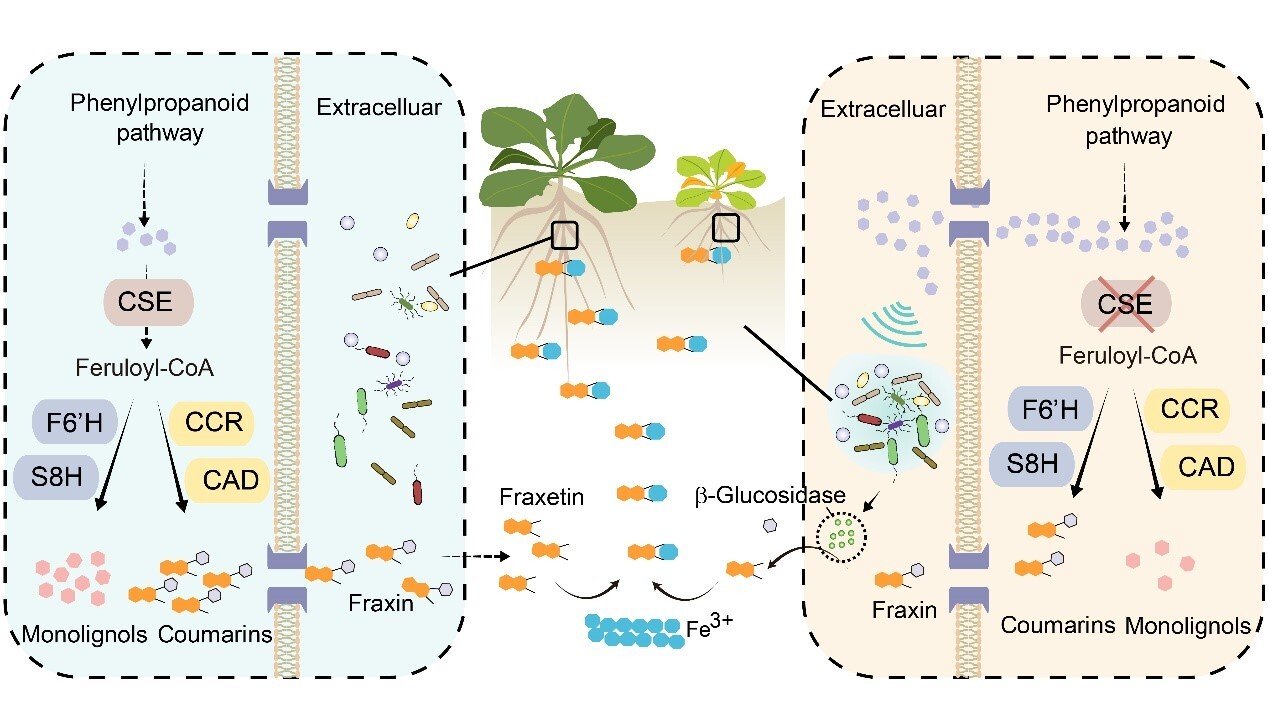
Root specialized metabolites (RSMs) comprise diverse, functional, plant-derived small molecules that can shape plant fitness by modulating rhizosphere microbe community, although the ecological functions and dynamics of RSM–microbe interactions remain elusive. Here, to explore how metabolic alterations influence microbiota assembly, we applied systematic multi-omics, phenotypic, and functional profiling of growth phenotypes, root metabolomes, and rhizosphere microbiota in 16 Arabidopsis thaliana mutants, defective in four distinct specialized metabolic pathways, under alkaline agricultural soil conditions. This paradigm identified genotype-enriched, rather than pathway-specific, correlations between RSMs and microbes. Notably, the cse-2 lignin biosynthesis mutant exhibited chlorosis and growth retardation under iron-deficiency, accompanied by decreased coumarins, but increased aromatic glycosides, with enrichment of Actinobacteria and Pseudomonadota taxa harboring aromatic compound-degrading pathways. Co-incubation of root exudates with a synthetic microbial community demonstrated that microbial deglycosylation predominantly underlies the dynamic transformation of such RSMs. Additionally, we identified a secreted β-glucosidase (A594_07591) in these microbes that preferentially hydrolyzes coumarin glycosides. Inoculation with Pseudomonas simiae WCS417r heterologously expressing A594_07591 significantly alleviated the iron-deficiency plant phenotype by converting catecholic coumarin glycosides to aglycones. This study uncovers a cooperative plant–microbe mechanism that transforms coumarins to promote iron acquisition under alkaline conditions and underscores the dynamic remodeling of RSMs in the rhizosphere as a key driver of plant fitness under environmental stress.