2026-05-20 徳島大学
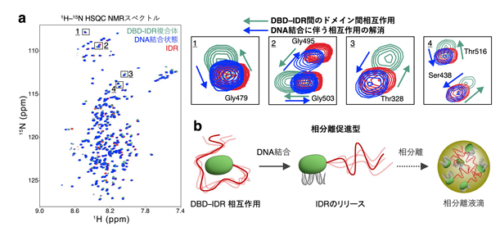
図1. DNA結合によるHsf1の立体構造変化 a: Hsf1 のNMRスペクトルと拡大図。
出典:DNA-Induced Entropic Gain Triggers an Allosteric Switch for Biomolecular Condensation of Heat Shock Transcription Factor 1, Kawagoe et al., Angewandte Chemie International Edition, CC BY 4.0.
<関連情報>
- https://www.tokushima-u.ac.jp/docs/71823.html
- https://www.tokushima-u.ac.jp/fs/5/0/3/7/5/8/_/260520_pressrelease.pdf
- https://onlinelibrary.wiley.com/doi/10.1002/anie.7340537
DNA結合に伴うエントロピー増大は、熱ショック転写因子1の生物学的相分離におけるアロステリックスイッチを制御する DNA-Induced Entropic Gain Triggers an Allosteric Switch for Biomolecular Condensation of Heat Shock Transcription Factor 1
Soichiro Kawagoe, Hiroyuki Kumeta, Tomohide Saio
Angewandte Chemie International Edition Published: 19 May 2026
DOI:https://doi.org/10.1002/anie.7340537
ABSTRACT
The molecular logic of how site-specific DNA recognition by a transcription factor (TF) is transduced into macroscopic protein condensation remains a fundamental puzzle in chemical biology. Here, we unveil that the structured DNA-binding domain (DBD) of a TF acts as an entropic switch to regulate the release of the intrinsically disordered region (IDR). Using high-resolution solution NMR spectroscopy, we demonstrate that DNA binding significantly shifts the conformational equilibrium of the DBD toward a highly dynamic state. This conformational shift allosterically triggers the release of the IDR, thereby promoting macroscopic biomolecular condensation via multivalent interactions between the IDR and other molecules. Our findings define a mechanism of entropy-driven allostery, providing a structural and thermodynamic basis for how DNA-encoded information is transduced into macroscopic phase behavior.