2026-04-30 カリフォルニア大学サンディエゴ校(UCSD)
<関連情報>
- https://today.ucsd.edu/story/predicting-genetic-risk-for-type-1-diabetes-just-got-more-accurate-thanks-to-uc-san-diego-study
- https://www.nature.com/articles/s41588-026-02578-y
遺伝子関連解析と機械学習により、1型糖尿病リスクの予測精度が向上する Genetic association and machine learning improve the prediction of type 1 diabetes risk
Carolyn McGrail,Timothy J. Sears,Emily N. Griffin,Alexandra L. Ghaben,Patrick Smadbeck,Jason Flannick,Parul Kudtarkar,Hannah Carter & Kyle Gaulton
Nature Genetics Published:30 April 2026
DOI:https://doi.org/10.1038/s41588-026-02578-y
Abstract
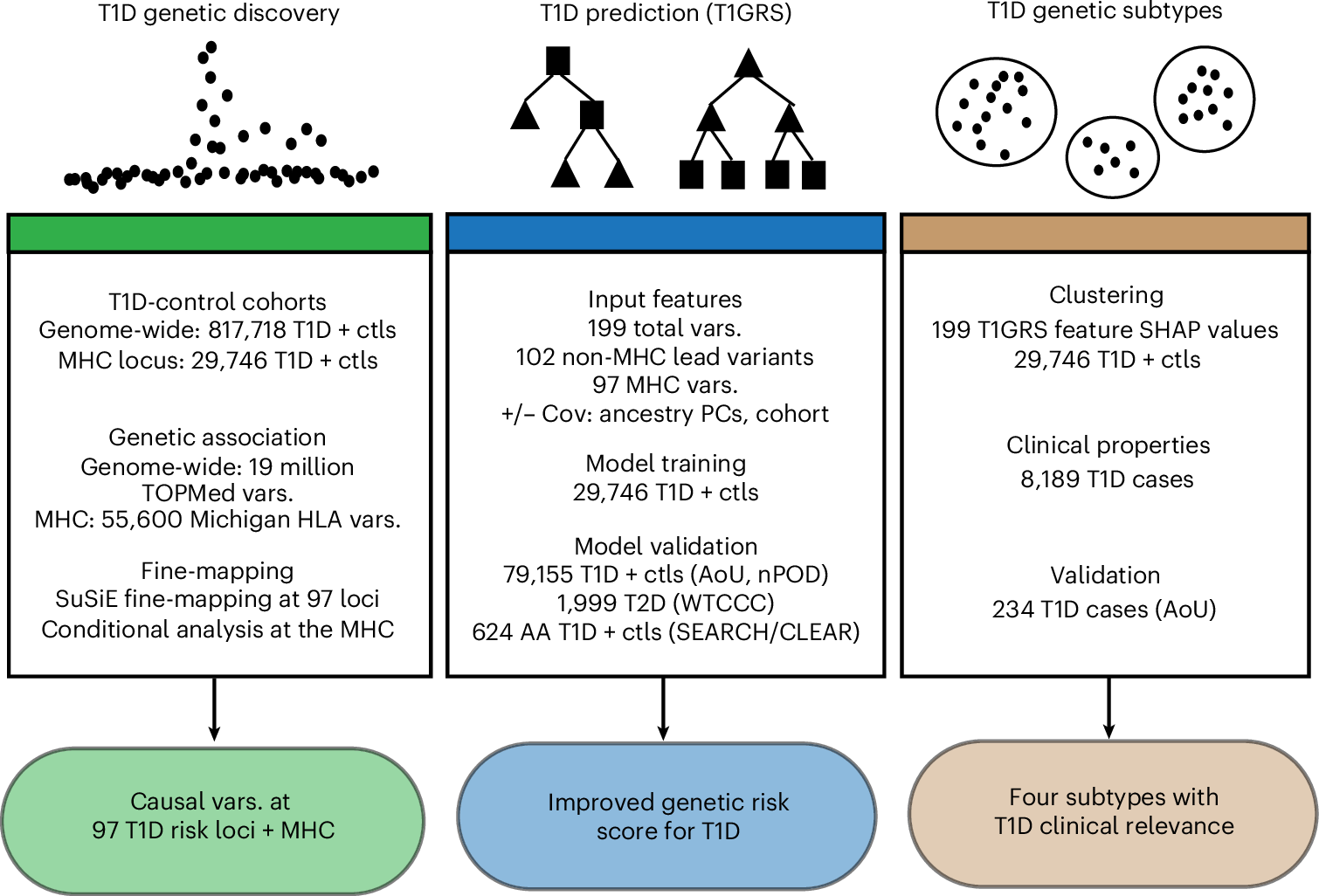
Type 1 diabetes (T1D) has a large genetic component, and expanded genetic studies of T1D can enhance biological and therapeutic discovery and improve risk prediction. Here we performed genome-wide genetic association and fine-mapping analyses in 20,355 T1D and 797,363 nondiabetic individuals of European ancestry and in 10,107 T1D and 19,639 nondiabetic individuals at the MHC locus, which identified 160 risk signals. We trained a machine learning model, T1GRS, to predict T1D using genetic risk, which improved classification in Europeans and performed similarly in African Americans, compared to previous scores. T1GRS particularly improved prediction in T1D, with fewer high-risk HLA haplotypes and more complex risk profiles, and revealed 154 nonlinear interactions between MHC and non-MHC loci. Finally, we identified four genetic subclusters based on T1GRS features with significant differences in age of onset and diabetic complications. Overall, improved genetic discovery and prediction will have wide clinical, therapeutic and research applications for T1D.