2026-04-30 カリフォルニア大学サンディエゴ校(UCSD)
<関連情報>
- https://today.ucsd.edu/story/researchers-uncover-strategy-to-help-exhausted-immune-cells-fight-tumors
- https://www.cell.com/cell/fulltext/S0092-8674(26)00226-6
プロテオスタシスはT細胞の分化能と腫瘍浸潤リンパ球の機能を維持する Proteostasis sustains T cell differentiation potential and tumor-infiltrating lymphocyte function
Nicole E. Scharping ∙ Xuezhen Ge ∙ Maria Inês Matias ∙ … ∙ Samuel A. Myers ∙ Eric J. Bennett ∙ Ananda W. Goldrath
Cell Published:April 29, 2026
DOI:https://doi.org/10.1016/j.cell.2026.02.019
Highlights
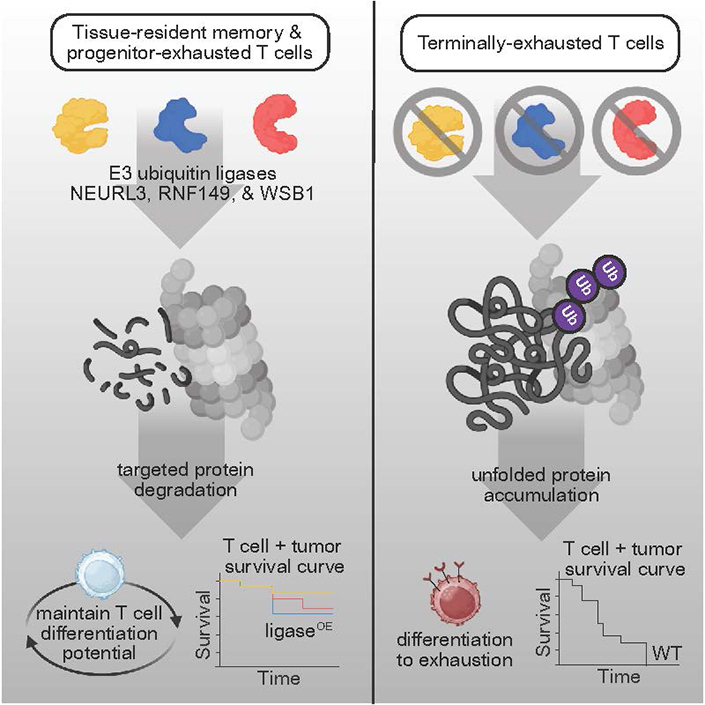
- TRM and TPEX share expression of proteostasis-related genes
- TEX experience loss of proteostasis, including accumulation of unfolded proteins
- Ex vivo T cell proteomics reveals biological pathways not reflected in transcriptomes
- E3 ligases rescue proteostasis and improve immunotherapeutic responses to cancer
Summary
Tumor-infiltrating lymphocytes (TIL) often fail to restrain tumor growth due to progressive differentiation into an “exhausted” state. Tissue-resident memory T cells (TRM) maintain protection from infection for years in healthy tissues, and patient tumors that contain TIL with TRM features are associated with better prognosis. Proteomic and transcriptomic profiling of T cell populations identified proteostasis as a significant factor distinguishing TRM and progenitor-exhausted TIL from terminally exhausted TIL, including loss of E3 ubiquitin ligases NEURL3, RNF149, and WSB1, with accumulation of unfolded proteins despite functional proteasome activity. Enforced expression of these ligases in T cells preserved stem-like TCF1+ populations and improved function in tumors and chronic infection, whereas deficiency impaired TIL and altered T cell differentiation during acute infection. Sustained ligase expression rescued the accumulation of unfolded proteins in TIL and improved immunotherapy outcomes in preclinical models, underscoring the critical role of proteostasis in TIL function and highlighting a promising avenue for advancing cancer immunotherapy.