2026-06-29 東京科学大学
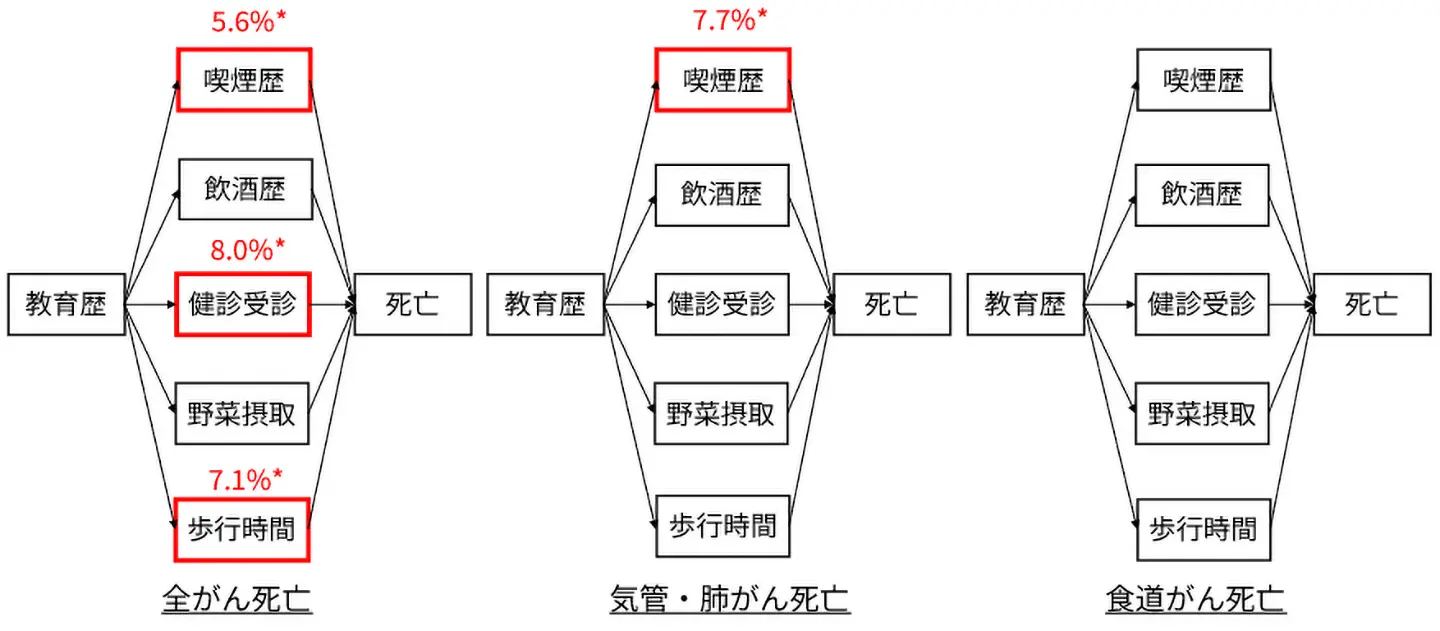
図. 教育歴とがん死亡との関連を健康習慣が媒介する割合
*p<0.05 有意差が見られた変数の割合を記載
<関連情報>
- https://www.isct.ac.jp/ja/news/1shvkpgsao48
- https://www.jstage.jst.go.jp/article/jea/advpub/0/advpub_JE20260014/_article
教育格差が全がん死亡率および部位別がん死亡率に与える影響:日本の7年間コホート研究に基づく健康行動の媒介分析 Educational inequalities in all and site-specific cancer mortality: Mediation analysis of health behaviors from a 7-year cohort study in Japan
Sakura Kiuchi, Yusuke Matsuyama, Toshiyuki Ojima, Masashige Saito, Katsunori Kondo, Ken Osaka, Jun Aida
Journal of Epidemiology Published:June 06, 2026
DOI:https://doi.org/10.2188/jea.JE20260014
Abstract
Background
Previous studies have reported educational inequalities in all and site-specific cancer mortality. However, the mechanisms underlying this association remain unclear. We investigated the association between educational level and all- and site-specific cancer mortality and examined potential mediating factors.
Methods
We conducted a longitudinal study using data from the Japan Gerontological Evaluation Study (JAGES), initiated in 2010 with 7-year follow-up targeting independent adults aged ≥65 years. Self-report questionnaire data were linked to mortality records from municipal registries. Educational level was exposure (<10/10–12/>12 years for competing risk models and <10/≥10 years for causal mediation analysis). All- and site-specific cancer mortality were outcomes. Competing risk models estimated sub-distribution hazard ratios (SHRs) and 95% confidence intervals (CIs). Causal mediation analysis assessed mediating effects of smoking status, drinking status, health examination, vegetable and/or fruit intake, and walking time.
Results
Among 43,478 participants (46.6% men, mean age 73.7 years), the 7-year mortality from all cancers was 5.1%. Low educational level was associated with higher all-cancer mortality (SHR for the lowest compared with the highest 1.27; 95%CI, 1.13–1.44). Similar associations were observed for tracheal and lung, and esophageal cancer mortality. The association between educational level and all cancer mortality was significantly mediated by smoking status (5.6%), health examination (8.0%), and walking time (7.1%), but not by drinking status and vegetable and/or fruit intake.
Conclusion
Lower educational level was associated with a higher risk of all cancer, tracheal and lung cancer, and esophageal cancer mortality. Health behaviors partially explained these associations.