2026-06-29 東京大学
貝類にとってフロンティア環境に適応したカタツムリ2種が示した貝殻の収斂進化
<関連情報>
- https://www.s.u-tokyo.ac.jp/ja/press/11178/
- https://link.springer.com/article/10.1186/s40851-026-00266-7
動的カモフラージュの収斂進化:樹上性カタツムリにおける湿度に反応する殻の色 Convergent evolution of dynamic camouflage: humidity-responsive shell colouration in arboreal snails
Taro Yoshimura & Takenori Sasaki
Zoological Letters Published:25 June 2026
DOI:https://doi.org/10.1186/s40851-026-00266-7
Abstract
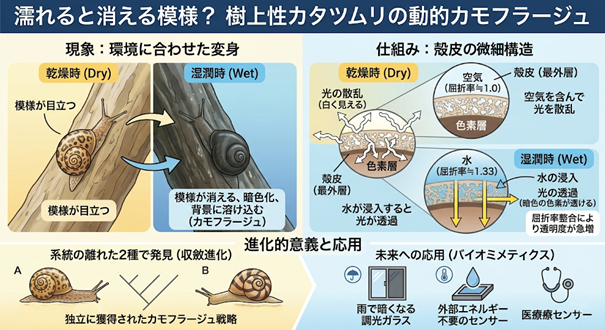
Terrestrial organisms employ diverse camouflage strategies, yet the fluctuating humidity and light conditions of arboreal habitats demand dynamic adaptations. This study investigated a novel mechanism of dynamic camouflage in the arboreal snails Hypselostyla camelopardalis (Camaenidae) and Reinia variegata (Clausiliidae). These phylogenetically distant species exhibit a reversible hygrochromic change: their mottled shell patterns disappear upon wetting, turning uniform dark brown, and rapidly reappear as they dry. Using a multimodal approach—including confocal laser microscopy, scanning electron microscopy, and spectrophotometry, this study shows that the colour change is associated with structural modifications within the bilayered organic periostracum. In the white regions, hydration fills microscale voids and smooths surface irregularities, effectively matching the refractive index of the periostracum and increasing light transmittance. While camouflage in terrestrial gastropods was previously considered static, our findings reveal an environmentally responsive system that dynamically adjusts to ambient moisture. This mechanism parallels strategies observed in certain insects, and is consistent with functional convergent evolution. Furthermore, the water-responsive thin-film structure of the snail shell provides a biological blueprint for the development of bioinspired smart materials, such as humidity-sensitive coatings and adaptive optical technologies.