2026-06-16 マウントサイナイ医療システム((MSHS)
<関連情報>
- https://www.mountsinai.org/about/newsroom/2026/ebola-virus-hides-in-the-central-nervous-system-according-to-new-research-led-by-microbiologists-at-the-icahn-school-of-medicine-at-mount-sinai
- https://www.nature.com/articles/s41564-026-02388-2
ヒト脳オルガノイドモデルにおけるエボラウイルス持続感染の宿主-ウイルス決定因子 Host–virus determinants of Ebola virus persistence in a human cerebral organoid model
Lina Widerspick,Santiago Vidal Freire,Johanna F. Steffen,Shruti Shirsathe,Petra Allartz,Molly A. Vickers,Christoph Henkel,Pedro Neira Pelén,Julia Nave,Monika Rottstegge,Michelle Heung,Stephanie Wurr,Dennis Tappe,Lisa Oestereich,Jonas Müller,Angelique Hoelzemer,Leonore Mensching,Thomas Hoenen,Nicole C. Kleinstreuer,Ian Crozier,John G. Bernbaum,Gabriella Worwa,Jens H. Kuhn,Gustavo Palacios & César Muñoz-Fontela
Nature Microbiology Published:12 June 2026
DOI:https://doi.org/10.1038/s41564-026-02388-2
Abstract
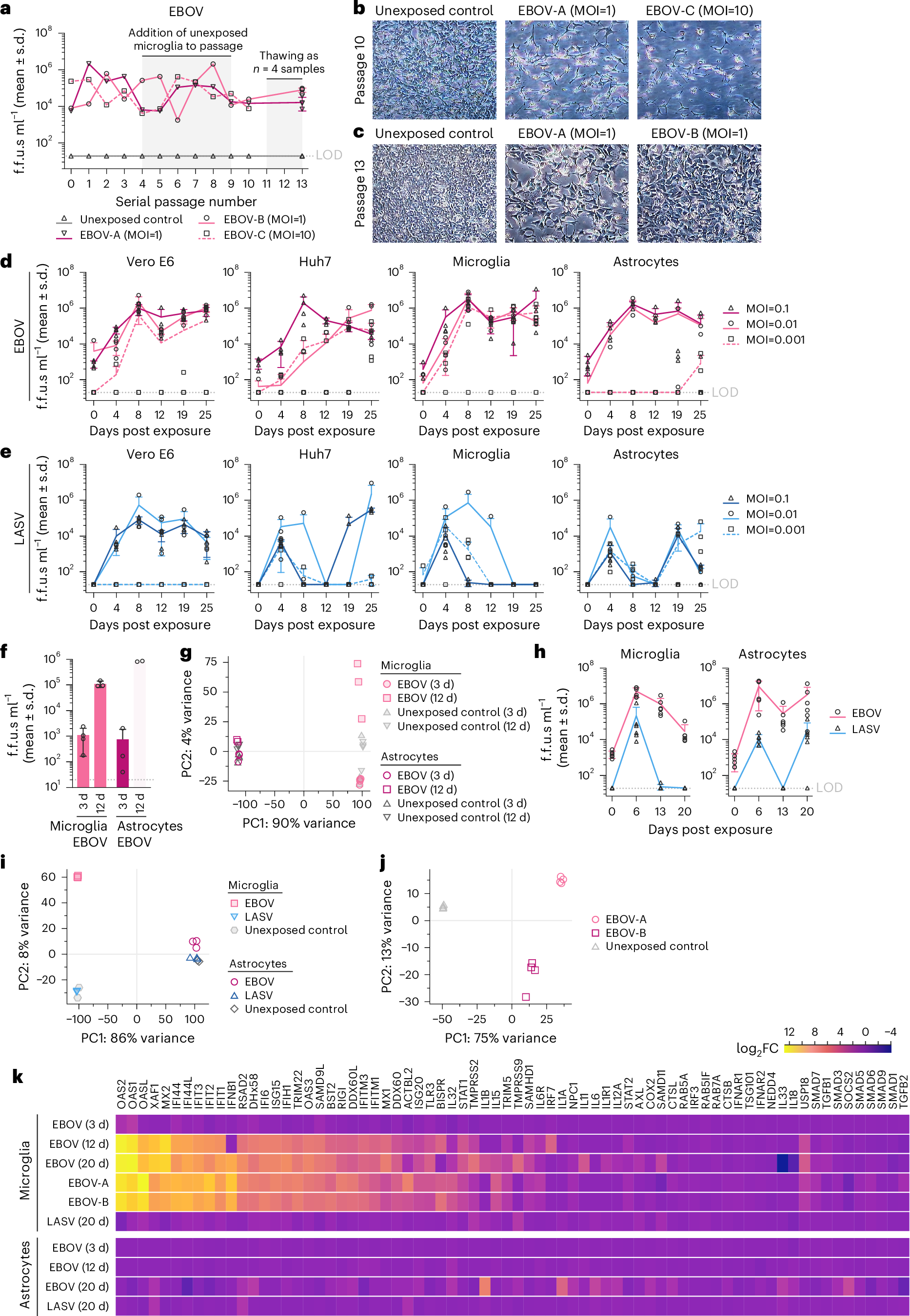
Ebola virus (EBOV) causes Ebola virus disease (EVD), a multisystemic human disease associated with an extraordinarily high case-fatality rate. EVD survivors may experience recrudescent inflammation with viral persistence in immune-privileged tissues, including the central nervous system (CNS). Persistence, defined by ongoing replication of the EBOV genome beyond the acute disease phase, may lead to virion production. Productive persistence has been linked to re-initiation of EVD outbreaks. We developed a human cerebral organoid model to investigate the host and viral determinants of EBOV CNS persistence. In this model, EBOV persistence for 120 days was sustained by continuous infection of astrocytes and neurons and the recruitment and infection of microglia. This was accompanied by the emergence of EBOV defective viral genomes and genomic subvariants, cell-to-cell transmission, activation of cell-specific innate immunity, and late brain organoid inflammation, indicating that persistent infection of EBOV within immune-privileged niches drives local inflammation.