
2026-07-14 ミュンヘン大学(LMU)
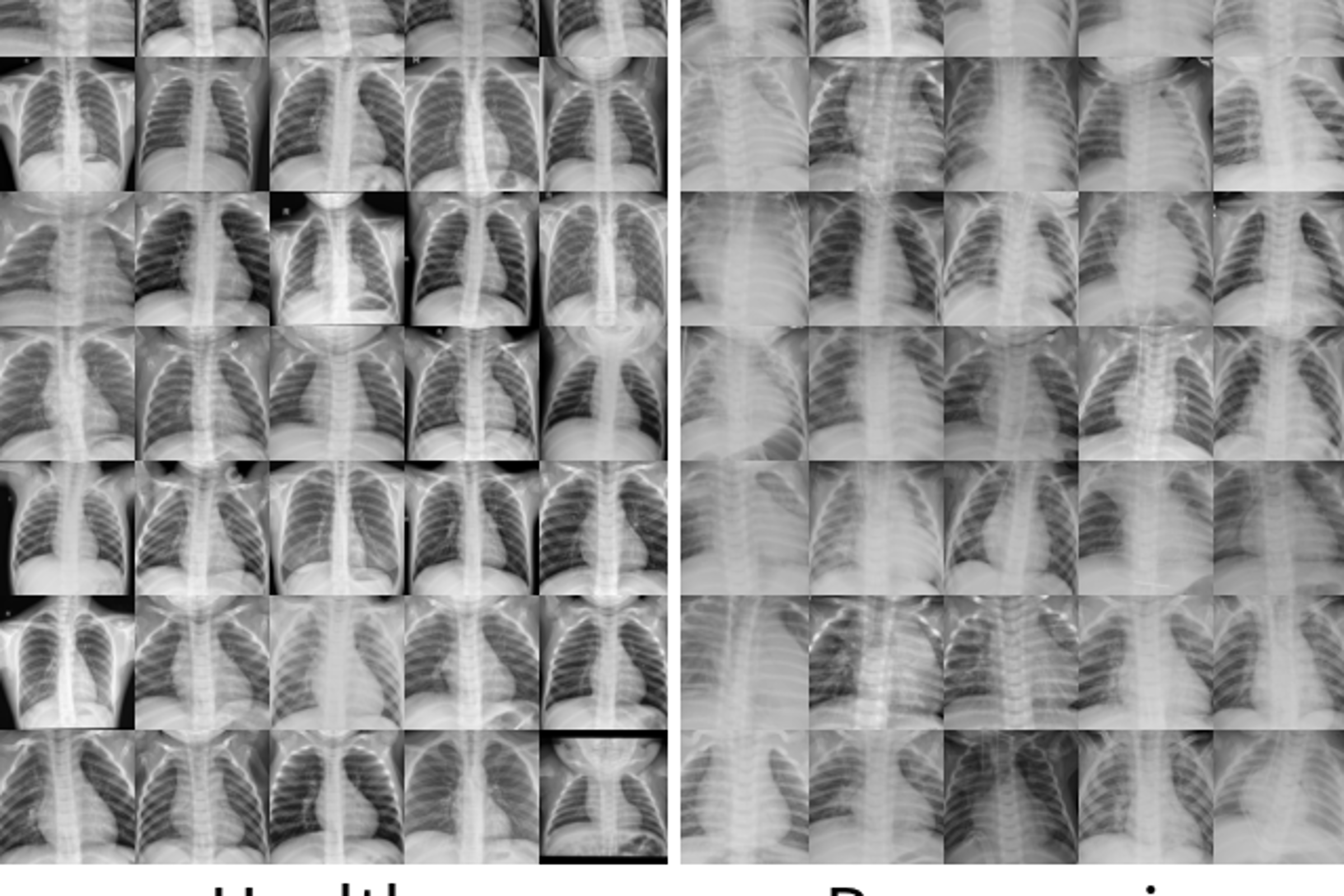
X-rays of healthy lungs alongside images of diseased lungs | © QuCUN / LMU
<関連情報>
- https://www.lmu.de/en/newsroom/news-overview/news/detecting-pneumonia-with-quantum-ai-b0e6afc4.html
- https://ieeexplore.ieee.org/document/11250242
並列アニーリングを用いた量子ボルツマンマシンによる医用画像分類 Quantum Boltzmann Machines Using Parallel Annealing for Medical Image Classification
Daniëlle Schuman; Mark V. Seebode; Tobias Rohe; Maximilian Balthasar Mansky; Michael Schroedl-Baumann; Jonas Stein:…
2025 IEEE International Conference on Quantum Computing and Engineering Date Added to IEEE Xplore: 01 December 2025
DOI:https://doi.org/10.1109/QCE65121.2025.00233
Abstract
Exploiting the fact that samples drawn from a quantum annealer inherently follow a boltzmann-like distribution, annealing-based Quantum Boltzmann Machines (QBMs) have gained increasing popularity in the quantum research community. While they harbor great promises for quantum speed-up, their usage currently stays a costly endeavor, as large amounts of QPU time are required to train them. This limits their applicability in the NISQ era. Following the idea of Noè et al. [1], who tried to alleviate this cost by incorporating parallel quantum annealing into their unsupervised training of QBMs, this paper presents an improved version of parallel quantum annealing that we employ to train QBMs in a supervised setting. Saving qubits to encode the inputs, the latter setting allows us to test our approach on medical images from the MedMNIST data set [2], thereby moving closer to real-world applicability of the technology. Our experiments show that QBMs using our approach already achieve reasonable results, comparable to those of similarly-sized Convolutional Neural Networks (CNNs), with a markedly smaller numbers of epochs than these classical models. Our using parallel annealing grants it a speed-up of almost 70% compared to regular annealing-based BM execution.

