2026-08-03 国立循環器病研究センター,大阪大学
※画像は生成AIを使用して作成。
<関連情報>
- https://www.ncvc.go.jp/pr/release/pr_53799/
- https://jamanetwork.com/journals/jamanetworkopen/fullarticle/2852071
小児院外心停止における救急隊到着前の自動体外式除細動器(AED)パッド装着 Automated External Defibrillator Pad Application Before EMS Arrival in Pediatric Out-of-Hospital Cardiac Arrest
Aoi Yamaguchi, BS; Aya Fukuzawa, PhD; Masaya Atsuta, BS:et al
JAMA Network Open Published:July 24, 2026
DOI:10.1001/jamanetworkopen.2026.25069
Key Points
Question What is the current rate of automated external defibrillator (AED) pad application before emergency medical service (EMS) arrival in pediatric out-of-hospital cardiac arrest (OHCA), and is AED pad application associated with neurological outcomes?
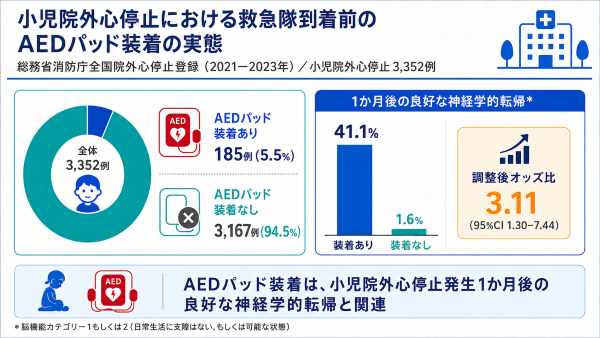
Findings In this cohort study of 3352 pediatric patients with OHCA in Japan, AED pads were applied before EMS arrival in 5.5% of pediatric OHCAs, and AED pad application was provided more often at school and when bystander CPR was provided, but less often at home, at night, and among infants. AED pad application was associated with higher 1-month survival with a favorable neurological outcome after OHCA.
Meaning These findings could serve as foundational data for formulating strategies to further increase AED pad application for pediatric patients with OHCA.
Abstract
Importance The current rate of automated external defibrillator (AED) pad application before emergency medical service (EMS) arrival in pediatric out-of-hospital cardiac arrest (OHCA) in Japan has not been sufficiently investigated.
Objective To describe the current rate of AED pad application and evaluate factors associated with AED pad application as well as factors associated with survival in pediatric patients with OHCA.
Design, Setting, and Participants This was a nationwide, prospective, population-based cohort study using data from the All-Japan Utstein Registry between 2021 and 2023. Pediatric patients with OHCA aged 0 to 17 years in whom resuscitation was attempted before EMS arrival were included. Data analyses were conducted from January to May 2026.
Exposure OHCA stratified by age (infants [<1 year], younger children [1-4 years], older children [5-12 years], and adolescents [13-17 years]).
Main Outcomes and Measures The outcome measures were the application of AED pads before EMS arrival as well as 1-month survival with a favorable neurological outcome, defined as a cerebral performance category scale of 1 or 2. Multivariable logistic regression analyses were performed to estimate adjusted odds ratios (aORs) and 95% CIs for factors associated with each outcome.
Results A total of 3352 pediatric patients with OHCA were analyzed. The median (IQR) age was 3 (1-4) years, 1983 patients (59.2%) were male, and 185 patients (5.5%) received AED pad application before EMS arrival. Arrests among infants (aOR, 0.28; 95% CI, 0.13-0.47) and younger children (aOR, 0.22; 95% CI, 0.10-0.49) vs adolescents, arrests occurring at home vs another public area (aOR, 0.06; 95% CI, 0.03-0.11), and arrests occurring at nighttime vs daytime (aOR, 0.52; 95% CI, 0.33-0.82) were significantly associated with a reduced probability of AED pad application before EMS arrival. In contrast, arrests occurring at school vs another public area (aOR, 6.74; 95% CI, 3.73-12.21) and receipt of bystander CPR (aOR, 28.69; 95% CI, 12.91-63.75) were associated with an increased probability of AED pad application before EMS arrival. Favorable neurological outcome was significantly higher in the AED pad application group than in the non–AED pad application group (aOR, 3.11; 95% CI, 1.30-7.44). Ventricular fibrillation as first documented rhythm had a large magnitude of association with increased favorable neurological outcome (aOR, 27.49; 95% CI, 13.95-54.19).
Conclusions and Relevance In this cohort study from Japan, approximately 5% of pediatric patients with OHCA received AED pad application before EMS arrival, and AED pad application was associated with higher odds of 1-month survival with a favorable neurological outcome. Further efforts are needed to increase AED access and use in public places where children gather, including schools.