2026-08-03 京都大学
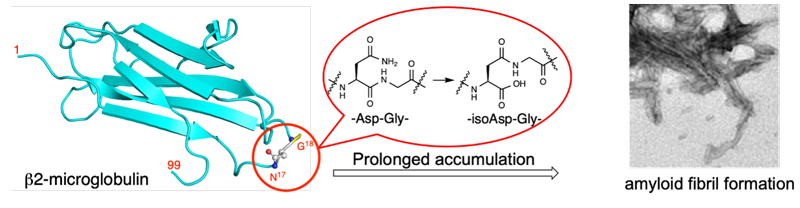
β2-ミクログロブリンのisoAsp化は、迅速なアミロイド線維を引き起こす。(https://doi.org/10.1002/anie.7045464、CC-BY-NC-NDライセンスの下で公開
<関連情報>
- https://www.kyoto-u.ac.jp/ja/research-news/2026-08-03-2
- https://onlinelibrary.wiley.com/doi/10.1002/anie.7045464
翻訳後イソアスパラギン酸はβ2-ミクログロブリンにおけるアミロイド形成を促進する Post-Translational Isoaspartate Promotes Amyloid Formation in β2-Microglobulin
Ryuji Kawakami, Toshiki Takei, Masatomo So, Toshifumi Takao, Yoshinori Taguchi, Hironobu Hojo
Angewandte Chemie International Edition Published: 08 June 2026
DOI:https://doi.org/10.1002/anie.7045464
ABSTRACT
β2-Microglobulin (β2m) aggregation is central to dialysis-related amyloidosis (DRA), yet the molecular triggers underlying its fibrillogenesis remain incompletely defined. Among proposed mechanisms, isoaspartate (isoAsp) formation at Asn residues has been implicated but never directly tested due to synthetic inaccessibility. Here, we report the total chemical synthesis of β2m variants containing isoAsp at known in vivo hotspots, Asn17 and Asn42, enabling precise structural and functional interrogation. Remarkably, the isoAsp17-modified β2m exhibited greater fibril formation capacity than the pathogenic ΔN6-β2m variant, suggesting a previously underappreciated contribution of isoAsp17. Structural characterization was complemented by spectroscopic and TEM analyses, which demonstrated that isoAsp17 promotes fibril formation. Our findings provide the first direct experimental evidence that a spontaneous post-translational modification can initiate amyloidogenesis in β2m, redefining the molecular basis of DRA and highlighting isoAsp as a general driver of pathological protein aggregation.