2026-08-03 京都大学
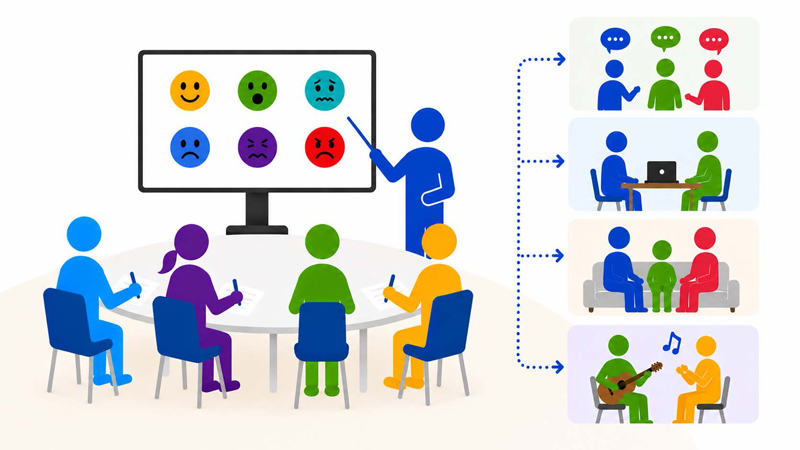
社会認知スキルトレーニングのイメージ図:
イラスト作成:大塚貞男、OpenAI ChatGPT(GPT-5、画像生成機能)を用いて作成
<関連情報>
- https://www.kyoto-u.ac.jp/ja/research-news/2026-08-03-1
- https://onlinelibrary.wiley.com/doi/10.1111/pcn.70106
統合失調症と⾃閉スペクトラム症における社会認知スキルトレーニングの異なる効果:評価者盲検・多施設ランダム化⽐較試験 Different effects of social cognitive skills training in schizophrenia and autism spectrum disorder: A rater-blinded, multicenter, randomized controlled trial
Sadao Otsuka PhD, Satsuki Oe MPH, Sumie Yamada PhD, Haruka Kumoi MHS, Ryoichi Suwabe MA, Tatsuro Iwane MHS, Kosuke Tsurumi MD, PhD, Toshiya Murai MD, PhD
Psychiatry and Clinical Neurosciences Published: 22 July 2026
DOI:https://doi.org/10.1111/pcn.70106
Abstract
Aim
Schizophrenia (SCZ) and autism spectrum disorder (ASD) are both characterized by social cognitive impairments that strongly predict poor functional outcomes. However, evidence-based social cognitive interventions have been developed only for SCZ. This study investigated the feasibility and efficacy of social cognitive skills training (SCST), focusing on both common and different effects on SCZ and ASD.
Methods
Forty-seven adults with SCZ and/or ASD were randomly assigned to SCST (n = 24) or a treatment-as-usual control (CON; n = 23). The Japanese version of SCST developed for this study comprised weekly 2-h group sessions over 6 weeks and targeted two social cognition levels: lower-level emotional processing and higher-level theory of mind. Blinded raters assessed social cognition, neurocognition, clinical symptoms, and functioning at baseline, post-intervention, and 6-week follow-up.
Results
SCST significantly improved facial emotion perception across diagnoses and demonstrated a trend-level ASD-specific improvement in theory of mind. These effects were maintained and generalized to improved global functioning only for ASD at follow-up. High attendance and positive participant feedback in both groups indicated the intervention’s feasibility.
Conclusion
This study provides initial evidence supporting the feasibility and efficacy of social cognitive interventions as a transdiagnostic approach for SCZ and ASD and is the first to show functional benefits in adults with ASD. The findings highlight both shared and disorder-specific mechanisms of social cognitive impairments and support the development of hybrid interventions that integrate transdiagnostic core components with tailored, diagnosis-sensitive modules for diverse psychiatric populations.
Clinical Trial Registration
The study protocol was preregistered on the University Hospital Medical Information Network Clinical Trials Registry (UMIN000041619; https://center6.umin.ac.jp/cgi-open-bin/ctr/ctr_view.cgi?recptno=R000047105; September 7, 2020).