2026-08-03 京都大学
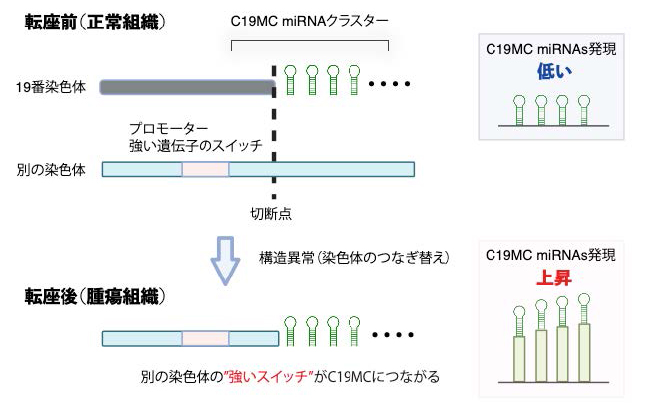
UESL/MHLでは、C19MC miRNAクラスターの構造異常により、C19MC miRNAの発現が著しく増加します。
<関連情報>
- https://www.kyoto-u.ac.jp/ja/research-news/2026-08-03-0
- https://www.nature.com/articles/s41698-026-01563-2
C19MC の活性化およびTP53の欠失を介した、肝間葉性過誤腫から肝未分化胎児性肉腫への段階的な悪性転化 Stepwise malignant transformation from MHL to UESL via activation of C19MC and loss of TP53
Yoshinori Uchihara,Keiji Tasaka,Takashi Mikami,Yosuke Yamada,Hiroaki Ito,Hajime Okita,Ryunosuke Tojo,Ryo Akazawa,Kiyotaka Isobe,Tatsuya Kamitori,Masahiko Nishitani-Isa,Hirohito Kubota,Satoshi Saida,Itaru Kato,Tatsuya Okamoto,Eri Ogawa,Hideaki Okajima,Yukichi Tanaka,Takako Yoshioka,Nobuyuki Kakiuchi,Yuichi Shiraishi,Tetsuya Takimoto,Shugo Komatsu,Mitsutaka Shiota,… Junko Takita
npj Precision Oncology Published:14 July 2026
DOI:https://doi.org/10.1038/s41698-026-01563-2 Unedited version
Abstract
Undifferentiated embryonal sarcoma of the liver (UESL) and mesenchymal hamartoma of the liver (MHL) are rare pediatric liver tumors with poorly understood oncogenic mechanisms. Although UESL occasionally arises from MHL, the relationship between these entities remains elusive. Here, we conducted comprehensive multi-omics profiling of 18 UESL and six MHL cases, and identified structural variants (SVs) involving the C19MC miRNA cluster in all tumors, resulting in robust overexpression of C19MC miRNAs. While mutations in TP53 were detected in all UESL samples, they were absent from MHL. Functional studies demonstrated that overexpression of C19MC miRNAs alone was insufficient for transformation, but acted synergistically with TP53 loss to drive oncogenicity. Spatial transcriptomics performed on a tumor sample containing a composite MHL-UESL lesion revealed pseudo-temporal gene expression trajectories and clonal diversification. Collectively, these findings delineate a stepwise malignant transformation from MHL to UESL, and reveal the underlying cooperative genetic events.