
2026-08-05 スタンフォード大学
<関連情報>
- https://news.stanford.edu/stories/2026/08/study-extreme-heat-seniors-life-space-mobility
- https://academic.oup.com/innovateage/article/10/5/igag027/8627017?login=false#562235641
高齢者の気温と生活空間移動における季節変動:モバイルヘルス技術を用いたパイロット研究 Seasonal variation in temperature and life-space mobility among older adults: a pilot study using mobile health technology
Annabel X Tan, PhD, MPH,Sylvie Dobrota Lai, MS,Vishnu Ravi, MD,J David Rhodes, MPH,Suzanne E Judd, PhD,Michelle C Odden, PhD
Innovation in Aging Published:07 April 2026
DOI:https://doi.org/10.1093/geroni/igag027
Abstract
Background and Objectives
Extreme outdoor temperatures are known barriers to physical activity and may constrain life-space mobility, the geographic footprint of where people live, work, and recreate, and an important indicator of health and independence among older adults. We conducted a pilot study to evaluate the feasibility of a mobile health (mHealth) app designed to objectively capture life-space and to demonstrate its utility through a downstream analysis of ambient temperature and life-space mobility.
Research Design and Methods
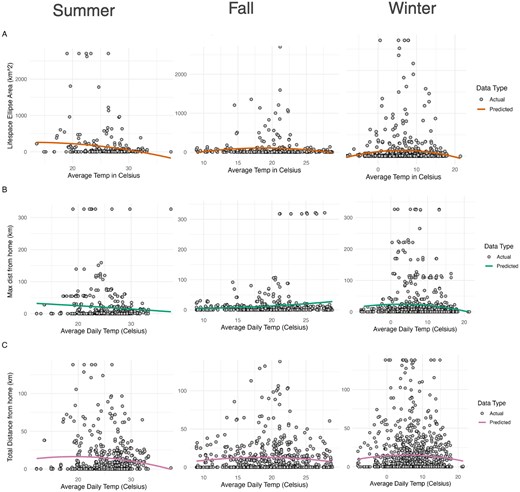
Using data collected via an iPhone app from 82 participants in an ongoing cohort study (June 2023-January 2024), we used linear mixed-effects models to examine associations between daily average temperature and 3 objective life-space measures: ellipse area, maximum distance traveled, and total distance traveled. Models were stratified by season and adjusted for relative humidity and sociodemographic covariates.
Results
The app successfully captured high-resolution longitudinal mobility data over 2 weeks per participant. There was a significant negative nonlinear association between higher daily average temperature and life-space in the summer. With the peak life-space ellipse area observed at 28.8 °C, for every degree Celsius greater than 28.8 °C, we found a statistically significant decrease in ellipse area by 2.97 km2 (95% CI: −5.45, −0.51; p = .02). Findings were similar for the outcomes of maximum and total distances traveled.
Discussion and Implications
This study demonstrates that mHealth technology is a feasible tool for assessing life-space mobility in older adults. Higher temperatures are associated with lower life-space metrics, highlighting the potential of app-derived metrics as digital biomarkers for mobility research.

