2026-08-14 マサチューセッツ工科大学(MIT)
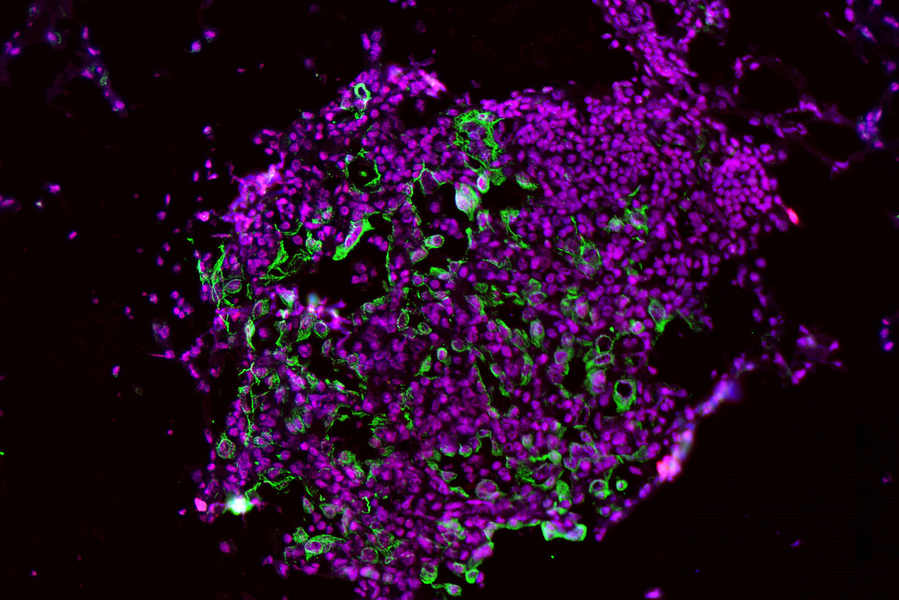
Caption: These lung tumor cells show high levels of the enzyme caspase-1 (green and red stains). This image was taken early in the tumor’s development. Credit: Courtesy of the researchers
<関連情報>
- https://news.mit.edu/2026/drug-targeting-inflammatory-enzyme-could-help-prevent-lung-cancer-0814
- https://www.science.org/doi/10.1126/sciadv.adz4263
炎症誘発性プロテアーゼ活性のマルチモーダルプロファイリングにより、カスパーゼ-1が肺がん治療の標的として同定された Multimodal profiling of pro-inflammatory protease activity identifies caspase-1 as a target for lung cancer interception
Cathy S. Wang, Qian Zhong, Shih-Ting Wang, Carmen Martin-Alonso, […] , and Sangeeta N. Bhatia
Science Advances Published:14 Aug 2026
DOI:https://doi.org/10.1126/sciadv.adz4263
Abstract
Systemic inhibition of interleukin-1b (IL-1b) has been shown to reduce the incidence of lung cancer in patients in years after treatment, but knowledge gaps surrounding its activation and role in the tumor microenvironment hinder cancer interception. We developed activity-based technologies to probe inflammation in early lung cancer and identified a translational target candidate. Probes sensitive to IL-1b–activating proteases were designed and applied to a murine model of inflammatory lung cancer, Kras/Trp53-mutant mice with SIINFEKL expression (KPS). Our nanosensors revealed elevated caspase-1 expression and activity in tumors, highlighting the importance of caspase-1 processing IL-1b during cancer development. We conducted a preclinical combination therapy trial by administering IL-1b blockade and caspase-1 inhibition. We observed significant reduction in lung cancer, including complete ablation of tumor incidence in nearly 20% of KPS mice. Our approach to understanding the interplay of protease activity and cytokine activation supports new strategies to mitigate inflammation and intercept lung cancer progression.