2026-09-08 国立遺伝学研究所
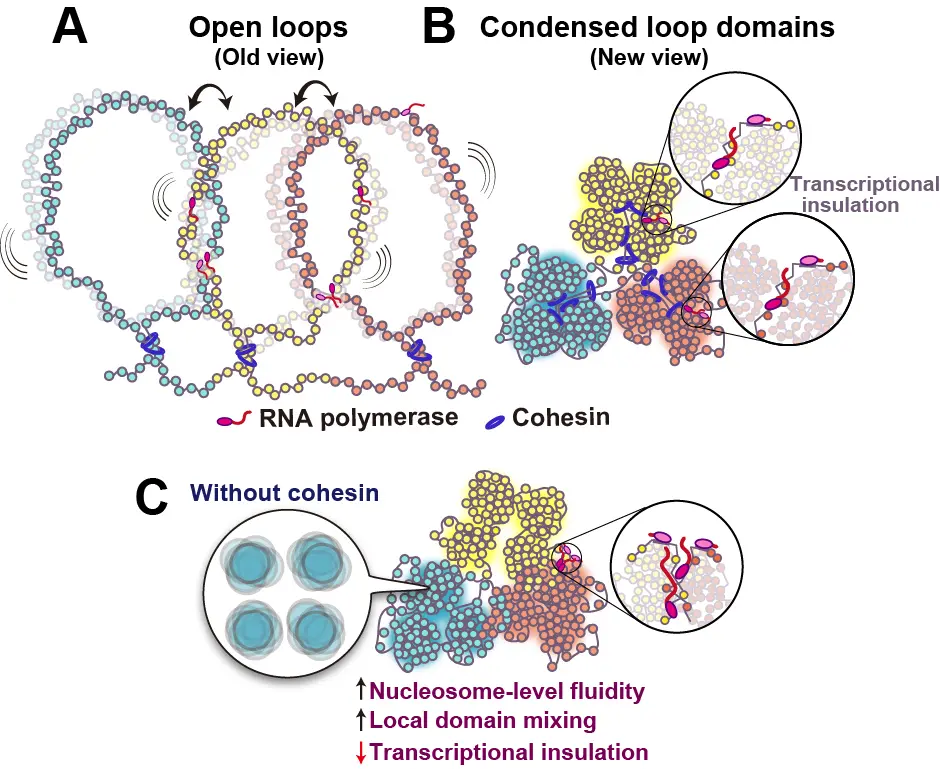
(A) ユークロマチンはオープンな構造であり、コヒーシンがDNAを束ねてループを形成すると考えられてきた。(B) 実際には細胞の中ではユークロマチンは流動性を保ちつつも、凝縮した塊(ドメイン)を作っていた。コヒーシンはクロマチンドメインを固くし、混ざらないようにしていた。(C) コヒーシンを迅速に除去すると、ドメインの流動性が増し、ドメイン同士が混ざりやすくなる。その結果、ドメインの転写制御が乱れ、隣接するドメインにある遺伝子の転写が同時に起こりやすくなったりする。
<関連情報>
コヒーシンは、生きたヒト細胞内で凝縮したユークロマチン領域の局所的な混合を防ぐ Cohesin prevents local mixing of condensed euchromatic domains in living human cells
Masa A. Shimazoe,Shiori Iida,Katsuhiko Minami,Koichi Higashi,Sachiko Tamura,Yoshiaki Kobayashi,Shin Fujishiro,Le Xiong,Kako Nakazato,S. S. Ashwin,Tomoko Nishiyama,Yu Nagata,Masato T. Kanemaki,Akane Kawaguchi,Yasuyuki Ohkawa,Lothar Schermelleh,Atsushi Toyoda,Liangqi Xie,Ken Kurokawa,Hiroshi Ochiai,Masaki Sasai & Kazuhiro Maeshima
Nature Genetics Published:08 September 2026
DOI:https://doi.org/10.1038/s41588-026-02736-2
Abstract
The human genome is folded into chromatin loops by the cohesin complex, forming functional chromatin domains that underlie transcription and DNA replication/repair. However, how cohesin organizes these domains in living cells, especially in active euchromatin, remains elusive. Here, to address this question, we combined single-nucleosome imaging/tracking and super-resolution three-dimensional structured illumination microscopy with euchromatin-specific labeling of histone variant H3.3. Using this nanoscopic approach, we revealed that euchromatin forms condensed domains that are constrained by cohesin-mediated loops. This organization refines the classical view of euchromatin as largely open, in line with emerging evidence. Transcription machinery appears to be located near the condensed domain surfaces/borders. Cohesin loss increased nucleosome-level fluidity within these domains without altering their overall compaction, leading to local mixing of domains and compromising transcriptional insulation. These findings suggest a physical role of cohesin in maintaining the integrity of condensed euchromatic domains and ensuring proper higher-order regulation of gene expression.