2026-04-16 コペンハーゲン大学(UCPH)
<関連情報>
- https://news.ku.dk/all_news/2026/04/elephant-genomes-reveal-a-past-of-continental-connectivity-and-a-future-of-increasing-isolation/
- https://www.nature.com/articles/s41467-026-71262-w
アフリカゾウにおける個体群の連結性と個体数減少がゲノムに及ぼす影響 The genomic impact of population connectivity and decline in Africa’s elephants
Patrícia Pečnerová,Yasuko Ishida,Genís Garcia-Erill,Laura D. Bertola,Cindy G. Santander,Xiaodong Liu,Anna Brüniche-Olsen,Anubhab Khan,Lauren M. Hennelly,Renzo F. Balboa,Long Lin,Malthe S. Rasmussen,Xi Wang,Mikkel Schubert,Amal Al-Chaer,Sylwia Urbaniak,Kan Nobuta,Sasha Treadup,Karine A. Viaud-Martinez,Alida de Flamingh,Ripan S. Malhi,Savanah Bird,Nelson Ting,Mrinalini Watsa,… Alfred L. Roca
Nature Communications Published:16 April 2026
DOI:https://doi.org/10.1038/s41467-026-71262-w
Abstract
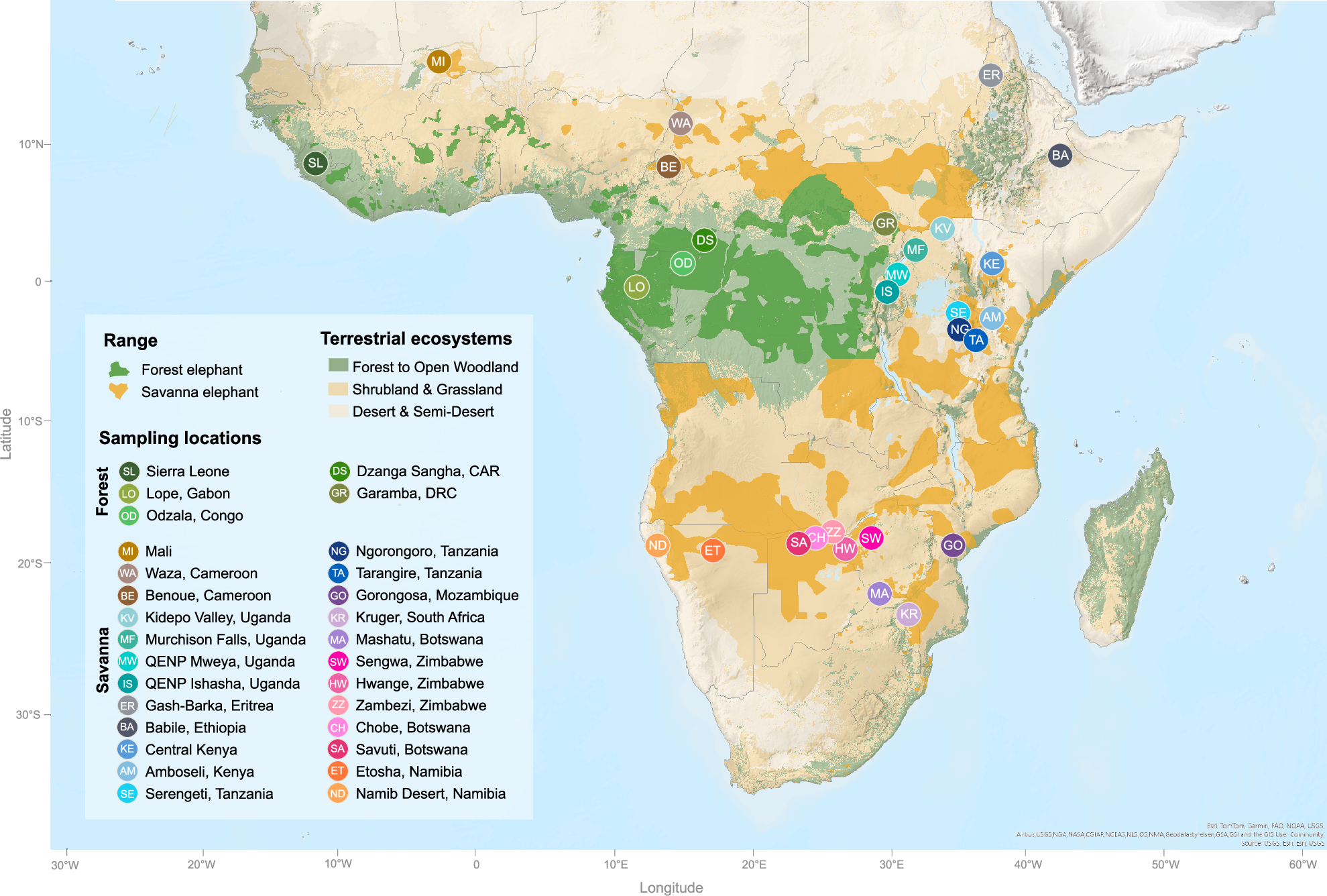
African elephants are keystone species facing severe declines due to the ivory trade and habitat loss. To investigate the genomic consequences, we analyze 232 high-coverage genomes from 17 African countries in the first continent-wide genomic analysis treating savanna (Loxodonta africana) and forest (L. cyclotis) elephants as distinct species. We find a deep divergence between species, with forest elephants showing higher heterozygosity and historically larger effective population sizes, while savanna elephants exhibit greater inbreeding and genetic load. Surprisingly, we detect widespread introgression of trace forest ancestry across savanna populations, suggesting a complex history of hybridization. Within species, historically high mobility promoted genetic connectivity, though we identify signs of human-induced isolation and drift in peripheral populations. Our findings highlight gene flow as a key force in African elephant evolution and underscore the urgency of understanding the impact of accelerating habitat fragmentation in these ecosystem engineers.